Astra Security
A hired hacker team on retainer, but mostly automated — instead of paying for one big annual penetration test and hoping nothing changed since, Astra's AI agents keep probing your app, APIs, and cloud setup continuously and hand real security experts the
🔗 Visit Astra Security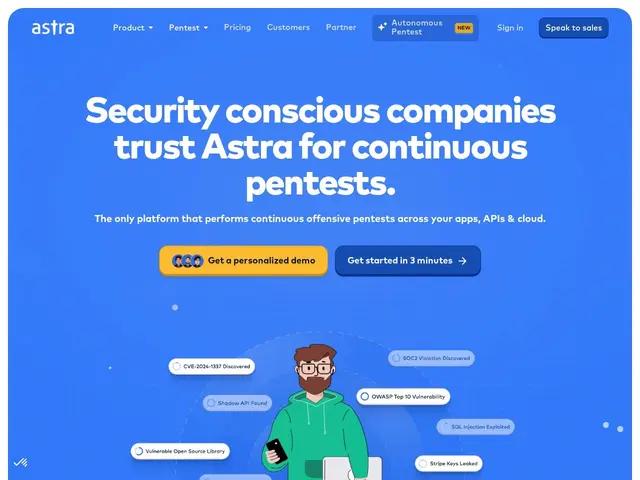
Description
A traditional penetration test happens once or twice a year, which means for months at a time a company has no real idea whether new code shipped last week introduced a new hole. Astra's answer is to make that testing continuous instead of an annual event: automated AI agents constantly probe for over 10,000 known vulnerability types, and the findings that need a human judgment call get escalated to certified pentesters rather than left as an unreviewed automated report.
Astra Security combines automated DAST (dynamic application security testing) scanning with human-led penetration testing across web applications, APIs, and cloud infrastructure (AWS, Azure, GCP), including authenticated scanning behind login screens, orphan/zombie API discovery, and dedicated AI/LLM app pentesting (prompt injection, context hijacking, output manipulation). It integrates with CI/CD pipelines, Jira, and Slack, offers SOC 2, HIPAA, and ISO 27001 compliance reporting, and is an established player (1,000+ customer organizations, a 4.6 G2 rating) rather than a brand-new startup. Pricing is tiered and public: DAST Scanner from $69-$499/month, API Security from $199-$499/month, Cloud Scanner from $99-$199/month, Penetration Testing from $1,999-$5,999/year, with custom enterprise pricing and a $7 trial.
💬 Our review
The short version: Astra is a mature, established security platform, not a speculative newcomer, and its combination of always-on automated scanning plus certified human pentesters addresses the real gap in traditional annual pentesting — that code ships continuously but audits don't.
Compared to a pure DAST tool, Astra's advantage is pairing automation with actual expert review of the findings that matter, which is a meaningful step up from a report full of automated false positives with no human triage. Compared to a pure pentest-as-a-service firm, Astra's continuous scanning between formal engagements closes the "blind months" gap. The pricing is refreshingly transparent for this category — most competitors quote everything custom — though the cumulative claims ("$69M+ in losses prevented," 2M+ vulnerabilities found) are aggregated marketing figures across all customers over an unspecified period, worth treating as directional credibility rather than a number that applies to any specific engagement.
💰 Pricing
📊 Global score
🤖 AI-enriched data
DAST Scanner : 69-499$/mois ; API Security : 199-499$/mois ; Cloud Scanner : 99-199$/mois ; Pentest : 1 999-5 999$/an ; Enterprise sur devis ; essai à 7$
Pros
Combine scan automatisé continu ET pentesters humains certifiés
10 000+ types de vulnérabilités testées, scan authentifié derrière login
Pentesting IA/LLM dédié (prompt injection, détournement de contexte)
Tarification publique et transparente, rare dans ce secteur
Cons
Chiffres cumulés ('69M$+ de pertes évitées') non vérifiables individuellement
Date de fondation et financement non précisés
Pentest humain reste facturé séparément et cher (1999$+/an)