Auriko
A price-comparison shopper for AI model calls — instead of always paying whatever your one chosen AI provider charges, Auriko checks prices across a dozen providers in real time and sends each request to whichever one is cheapest right now without changin
🔗 Visit Auriko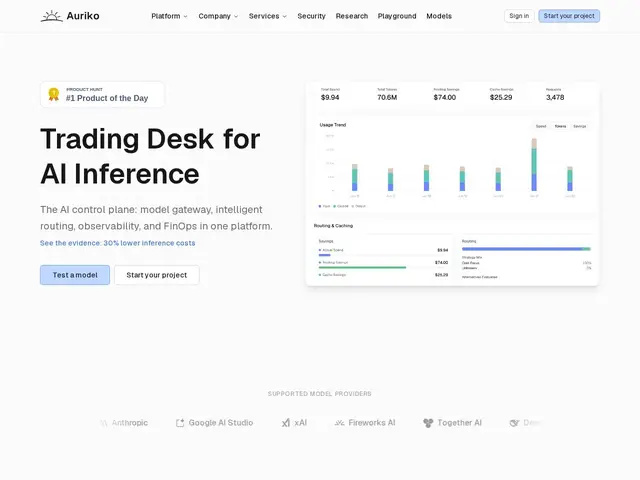
Description
If you've ever used a flight-comparison site instead of buying straight from one airline, you already understand Auriko: it sits between your app and the AI providers (OpenAI, Anthropic, Google, and others), watches prices and performance move in real time, and quietly routes each request to whichever provider offers the best deal at that moment — without you having to rewrite anything.
Auriko is a self-described "trading desk for LLM calls": an inference gateway built by former quantitative traders that prices every request across 12+ providers (OpenAI, Anthropic, Google AI Studio, xAI, Fireworks, Together AI, DeepSeek, and others), weighing token price, cache behavior, latency, and provider reliability before routing to the cheapest venue that won't degrade the response. It exposes a single OpenAI-compatible API, so switching means changing a base URL rather than your integration code, and it plugs into existing SDKs (OpenAI Agents SDK, Claude Agent SDK, LangChain, CrewAI, Vercel AI SDK). The company advertises roughly 30% average cost reduction versus calling providers directly — a plausible outcome of automated arbitrage, though it's a marketing figure that will vary by workload.
💬 Our review
The short version: if your AI API bill has become a real line item and you're only using one provider out of habit, Auriko is worth a trial — it's solving a genuinely annoying, genuinely solvable problem (nobody wants to hand-code fallback logic across a dozen LLM providers) rather than inventing a fake one.
Against similar LLM-gateway plays like OpenRouter or Requesty, Auriko's pitch leans harder on active cost-arbitrage ("trading desk") rather than just aggregation — that's a meaningful difference if your workload is price-sensitive and provider-agnostic, less so if you need a specific model's exact behavior for quality reasons, since a router that reroutes to a "good enough" cheaper model can silently change output quality. The real friction point is that Auriko doesn't publish pricing on its homepage, pushing prospective users to sign up before they can see what the gateway itself costs on top of the provider savings — worth checking net savings after Auriko's own margin before switching a production workload.
💰 Pricing
📊 Global score
🤖 AI-enriched data
Pas de grille tarifaire publique sur la page d'accueil — inscription requise pour voir les tarifs ; ~30% d'économie moyenne annoncée par rapport à un appel direct aux fournisseurs
Pros
API unique compatible OpenAI — bascule sans réécrire le code
Routage intelligent multi-fournisseurs (12+) selon coût/latence/fiabilité
Failover automatique en cas de panne d'un fournisseur
Contrôles de budget (limites, alertes) au niveau workspace/clé
Cons
Tarifs non publiés — inscription nécessaire pour voir le vrai coût
Le gain de 30% est un chiffre marketing, variable selon la charge réelle
Aucune info sur le financement ou l'équipe fondatrice