Replay QA
An AI tool that quietly clicks around your web app like a real visitor, then tells you exactly what broke — and where — before your actual users find out.
🔗 Visit Replay QA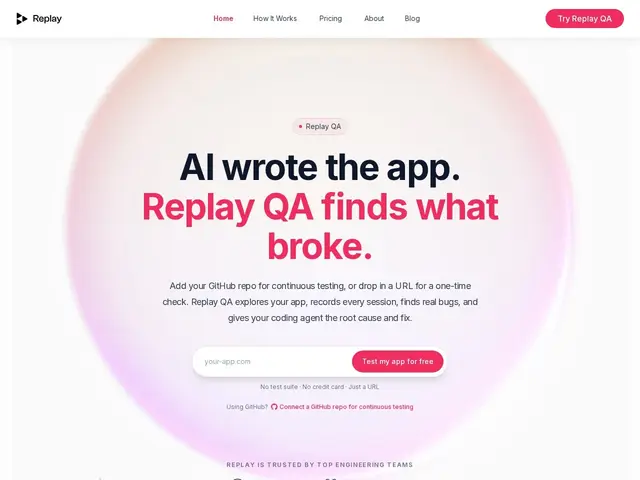
Description
Imagine hiring someone whose only job is to use your website all day, every day, clicking every button and filling every form, just to catch things that are broken before your customers do. That's essentially what Replay QA does, except it's software, it works around the clock, and it never gets bored or skips a page.
Replay QA is an autonomous testing platform built for teams shipping fast with AI coding tools, where traditional hand-written test suites can't keep pace with the rate of change. Point it at a URL or connect it to a GitHub repo, and it explores your app on its own — discovering user journeys, clicking through flows, and filling forms — while recording every session. When something breaks, it doesn't just flag a failure: it captures the root cause and hands your coding agent (or you) enough context to fix it, including support for authenticated flows and localhost/private apps. It can also generate and run real Playwright tests from what it discovers. Pricing is credit-based: a free tier (25 credits/month), Individual at $17/month (50 credits), Team at $170/month (500 credits), and custom Enterprise pricing — with the recording technology underneath already used in production by teams at Vercel, Glide, and Pantheon.
💬 Our review
The short version: if you're shipping code fast (especially AI-generated code) and don't have time to hand-write a test suite, Replay QA acts like a tireless QA intern who explores your app and reports back exactly what's broken and why.
Compared to writing Playwright or Cypress tests by hand, Replay QA's pitch is speed of setup — no config, no test files, just point it at a URL — which matters most for solo founders and small teams who'd otherwise skip QA entirely. Compared to error-monitoring tools like Sentry that only catch what real users trigger, Replay QA proactively explores paths users haven't hit yet, catching bugs before launch rather than after. The catch is the credit model: at $17/month for 50 credits, heavy daily testing on a complex app can burn through the Individual tier fast, and you'll want to budget for Team ($170/month) once you're testing continuously rather than occasionally. It's also fundamentally an exploration-and-report tool, not a replacement for deterministic CI test suites on business-critical logic — treat it as a safety net that catches what you didn't think to test, not the only net.
💰 Pricing
📊 Global score
🤖 AI-enriched data
Gratuit : 25 crédits/mois ; Individual $17/mois (50 crédits) ; Team $170/mois (500 crédits) ; Enterprise sur devis. 1 crédit ≈ 1 unité de travail QA.
Pros
Aucune configuration — pointe une URL et ça explore tout seul
Capture la cause racine du bug, pas juste le symptôme
Génère de vrais tests Playwright réutilisables
Intégration GitHub pour tester en continu
Cons
Modèle à crédits — peut coûter cher en usage intensif
Ne remplace pas une suite de tests déterministe pour la logique métier critique
Startup jeune, pas d'historique de fiabilité long terme