HarnessRouter
A single API that lets any app run AI coding agents like Claude Code or Codex in the background and get back real finished work — code, videos, documents — without the app's developers having to build the sandboxing and orchestration themselves.
🔗 Visit HarnessRouter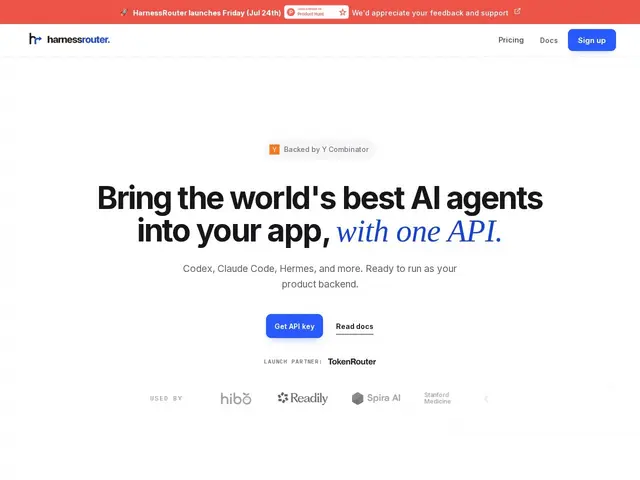
Description
Running an AI agent safely and reliably inside your own product is a real engineering project: you need sandboxes so the agent can't do damage, orchestration so it uses the right tools in the right order, session and file handling, retry logic, and cost controls. HarnessRouter's pitch is to have already built all of that, so a product team can send a task through one API and get back finished work, instead of spending months building agent infrastructure from scratch.
HarnessRouter lets developers run multiple sandboxed AI agents — including Codex, Claude Code, and Hermes, with more planned — behind a single API, producing real artifacts like code, files, videos, games, and documents for end users of the calling app. It handles the operational plumbing: sandbox environments, tool orchestration, file handling, sessions, streaming, retries, permissions, and cost controls, plus task tracing so developers can monitor what an agent did step by step. It's Y-Combinator backed and cites customers ranging from AI video-marketing startups to a top medical research institution using it to connect operational data into a unified 'academic brain.' Pricing is a 7-day free trial followed by tiered monthly plans (Developer, Production, Scale) with included credits and optional top-up balances that respect a set budget cap.
💬 Our review
The short version: HarnessRouter is infrastructure, not a product end users touch directly — it's for a team building an app that needs AI agents doing real background work, and would rather pay for that plumbing than build and maintain it themselves.
Compared to calling the Claude, OpenAI, or Codex APIs directly, HarnessRouter's value is entirely in the orchestration layer it adds on top: sandboxing, multi-agent swapping without code changes, retries, and cost controls that you'd otherwise have to build and maintain yourself, likely for months. The tradeoff is a classic infrastructure one — you're now depending on HarnessRouter's reliability and pricing on top of the underlying model providers' own uptime and cost, adding a layer of vendor dependency. For a team that's confident it needs multi-agent orchestration long-term and doesn't want to be an infra company on the side, that trade is usually worth it; for a team just prototyping with a single agent for one specific task, going direct to the model provider's API is simpler and has one less vendor in the chain.
💰 Pricing
📊 Global score
🤖 AI-enriched data
Essai gratuit 7 jours, puis plans mensuels Developer / Production / Scale avec crédits inclus + solde de recharge plafonné par un budget
Pros
Une seule API pour plusieurs agents (Codex, Claude Code, Hermes)
Sandboxing, orchestration, retries et contrôle des coûts déjà construits
Changement d'agent sans changement de code
Traçabilité des tâches étape par étape
Soutenu par Y Combinator
Cons
Ajoute une couche de dépendance fournisseur en plus des fournisseurs de modèles eux-mêmes
Moins pertinent pour un prototype simple avec un seul agent
Tarification précise des plans non détaillée publiquement au-delà de l'essai