Buzz
An open-source group chat where AI agents get to be real teammates — not bolted-on bots, but participants with their own identity, permissions, and a visible history of what they did — built by Block (Jack Dorsey's company) as a free alternative to Slack
🔗 Visit Buzz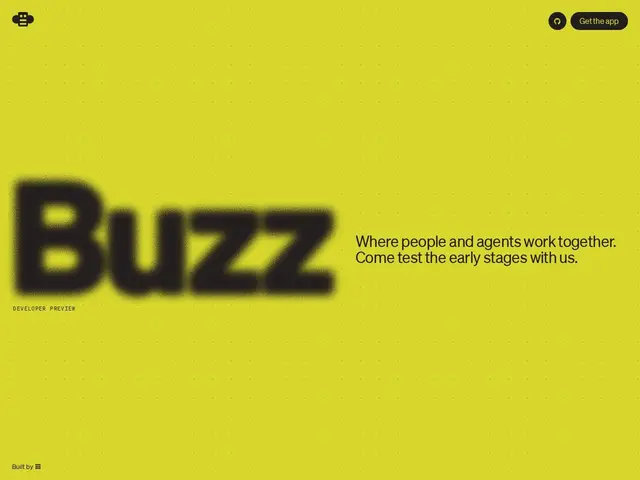
Description
Most team chat tools treat AI agents as an afterthought — a bot account bolted onto a system built for humans. Buzz starts from the opposite assumption: that teams now include both people and AI agents working together, so agents get their own real identity, their own permissions, and a visible audit trail of what they did, sitting in the same conversation as their human teammates instead of off in a sidebar.
Buzz is a free, open-source (Apache 2.0) group chat platform built on the decentralized Nostr protocol, launched by Block CEO Jack Dorsey in July 2026 explicitly to reduce teams' dependency on Slack and GitHub. It combines channels, direct messages, voice, file sharing, and Git repositories with automated workflows that can be triggered by messages, reactions, schedules, or external events. Because it's model-agnostic and decentralized, it already supports agents like Goose, Codex, and Claude Code working alongside human teammates with their own cryptographic identity and full history of what they touched. At launch it shipped as a desktop app for macOS, Windows, and Linux, with mobile apps not yet available.
💬 Our review
The short version: Buzz is a genuinely different bet on what team chat should look like once AI agents are regular participants rather than bots — worth watching closely, but it's brand new and currently missing pieces (like mobile apps) that established tools take for granted.
Against Slack, Buzz's core differentiator is treating agents as first-class citizens with real identity and audit trails baked into the protocol, rather than Slack's bot-API approach bolted on top of a human-first design — and being open-source and free removes the seat-based cost that scales painfully with team size on Slack. Against GitHub specifically, folding Git repositories into the same space as chat is a genuinely interesting consolidation, cutting down on context-switching between 'where we talk' and 'where the code lives.' The real risk is maturity: this is a July 2026 launch from a company (Block) with resources to sustain it, which is reassuring, but no mobile app yet and an ecosystem that's still forming means teams should expect some rough edges if they migrate fully today rather than run it alongside their existing tools first.
💰 Pricing
📊 Global score
🤖 AI-enriched data
Gratuit et open-source (licence Apache 2.0). Application desktop macOS/Windows/Linux ; apps mobiles pas encore disponibles.
Pros
Gratuit et open-source, pas de coût par siège
Agents IA traités comme de vrais participants avec identité et permissions propres
Dépôts Git intégrés directement dans l'espace de chat
Soutenu par Block (Jack Dorsey), ressources pour durer
Cons
Pas encore d'application mobile au lancement
Produit très récent (juillet 2026), écosystème encore en formation
Décentralisé via Nostr — courbe d'adoption différente d'un outil SaaS classique