SquidHub
A shared workspace where your whole team and their AI assistants can brainstorm, plan and write together in the same room in real time, instead of everyone copy-pasting between separate private AI chats.
🔗 Visit SquidHub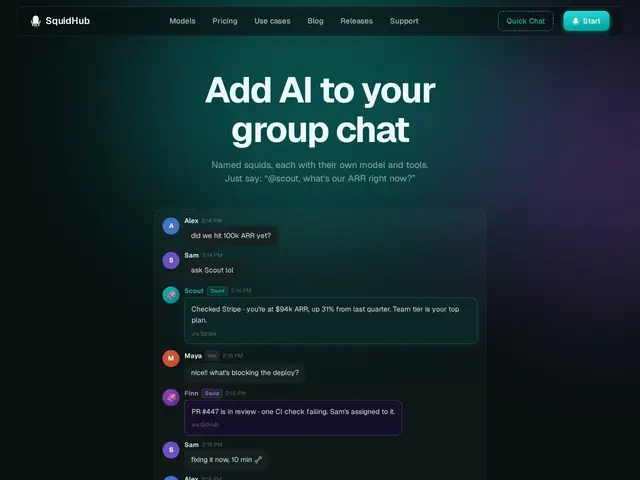
Description
Most teams now use AI chatbots individually — everyone has their own ChatGPT or Claude conversation, and if someone finds a useful answer, they copy-paste it into Slack for others to see, losing all the context behind it. SquidHub's idea is to make that collaboration happen directly: instead of a private chat per person, a team shares a room where humans and their AI agents (which SquidHub calls "squids") work side by side, in the open, on the same task.
SquidHub is a multiplayer AI collaboration platform: teammates and their AI agents join shared real-time rooms to brainstorm, plan, write and make decisions together, with everyone seeing the same conversation instead of fragmented private threads. It supports hosted Claude access or bringing your own API key for Claude, GPT, Grok or Gemini, so teams aren't locked into one model provider. Instruction bundles can be attached to any squid and reused across rooms, and squids can retain relevant context across sessions. Content is encrypted at rest with AES-256-GCM, and SquidHub is explicit that Anthropic applies zero data retention on requests routed through it — though, like any AI tool, content is necessarily in plaintext while a model is actively processing it. The company is self-funded with no venture capital, and doesn't publish detailed public pricing tiers, suggesting a freemium or usage-based model available on request.
💬 Our review
The short version: SquidHub is worth trying if your team's AI usage is currently a mess of individual ChatGPT tabs and copy-pasted answers, and you want a shared space where the AI conversation itself becomes team knowledge instead of disappearing into someone's private history.
The "multiplayer" framing is a genuinely different angle from most AI collaboration tools, which bolt AI onto an existing document or chat app — SquidHub builds the room around the human-plus-agent unit from the start, and letting teams bring their own model keys (rather than being locked to one vendor) is a real point in its favor for teams with existing API relationships. The honesty about plaintext-during-processing is also a good sign of a team that isn't overselling its security story. The main uncertainty is pricing: with nothing published publicly, you can't compare cost against a competitor like Slack-plus-a-shared-bot or Notion AI without actually signing up, and a self-funded, no-VC company is worth a quick gut-check on longevity before you build team workflows around it — though that same independence also means less pressure toward aggressive monetization or a sudden pivot.
💰 Pricing
📊 Global score
🤖 AI-enriched data
Aucun tarif public affiché ; modèle probable freemium/à l'usage, société autofinancée sans capital-risque
Pros
Salles partagées en temps réel où humains et agents IA travaillent ensemble, visibles par toute l'équipe
Compatible avec ses propres clés API Claude, GPT, Grok ou Gemini — pas de verrouillage fournisseur
Transparence honnête sur les limites de sécurité (plaintext pendant le traitement)
Société autofinancée, sans pression d'investisseurs à court terme
Cons
Aucun tarif public — impossible de comparer le coût sans s'inscrire
Produit jeune, pas d'historique long à évaluer
Documentation publique limitée sur les fonctionnalités avancées
Autofinancement = moins de moyens marketing/support qu'un concurrent financé