Falconer
A company knowledge base that updates itself — when the code changes or a decision gets made in Slack, Falconer notices and fixes the docs, instead of leaving them to quietly go stale.
🔗 Visit Falconer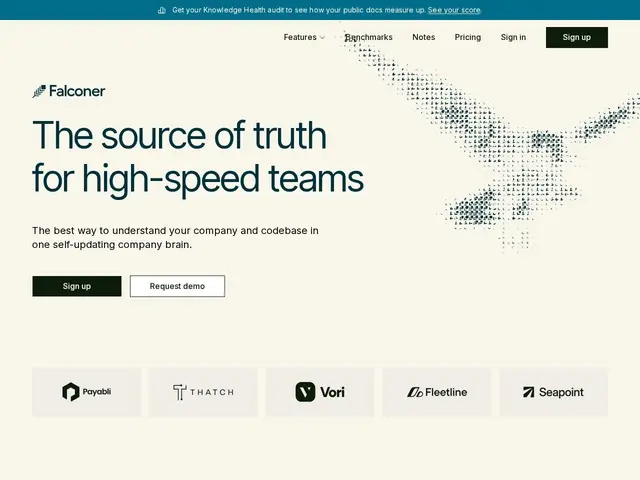
Description
Every engineering team writes documentation, and almost every engineering team watches it slowly become wrong: someone changes how a feature works, or a decision gets made in a Slack thread, and nobody remembers to update the wiki. Six months later a new hire follows outdated instructions and breaks something. Falconer's whole premise is to stop treating docs as a one-time writing task and instead keep them tied to the places where change actually happens — your code, your chat, your ticket tracker.
Falconer is a self-updating knowledge layer built specifically for engineering-led startups. It syncs with GitHub, Slack and Linear, so when a pull request changes behavior the relevant docs get flagged or updated automatically, and decisions made in Slack threads get captured into the knowledge base instead of disappearing. It includes a "Knowledge Health" audit that surfaces which docs are stale or missing, an AI writing editor to draft onboarding guides, changelogs and architecture docs grounded in your actual codebase (not generic AI output), and an MCP integration so coding assistants like Claude Code have accurate company context to work from. It's SOC 2 Type II certified, offers a free Starter plan for up to 3 users, a Pro plan at $20/user/month (10 users, annual billing) with auto-updates and Confluence/Google Drive sync, and custom Enterprise pricing with SSO, SAML and self-hosting.
💬 Our review
The short version: if your team's docs are already out of date and everyone privately knows it, Falconer's bet — tie the docs to the code and chat where the real information lives — is a genuinely sound fix for a problem most "just write better docs" advice fails to solve.
Compared to a general-purpose tool like Notion or Confluence, Falconer's advantage is narrow but real: it's built by people who ran internal knowledge systems at Stripe and Uber during hypergrowth, and the auto-flagging-on-code-change mechanic directly targets the actual failure mode (docs rot because nobody remembers to update them, not because writing tools are bad). At $20/user/month on Pro it's competitively priced against Notion's team tiers once you add AI features, and the free Starter plan is genuinely usable for a 3-person team to try it seriously. The tradeoff is scope: Falconer is purpose-built for engineering knowledge tied to GitHub/Slack/Linear, so if you need docs for non-technical teams (support, sales, HR) alongside engineering, a general tool like Notion still covers more ground in one place.
💰 Pricing
📊 Global score
🤖 AI-enriched data
Gratuit jusqu'à 3 utilisateurs ; Pro $20/utilisateur/mois facturé annuellement (10 utilisateurs) ; Enterprise sur devis (SSO, SAML, self-hosting)
Pros
Docs mises à jour automatiquement quand le code change (via GitHub)
Capture les décisions prises dans les threads Slack au lieu de les perdre
Audit « Knowledge Health » qui repère les docs obsolètes ou manquantes
Plan gratuit réellement utilisable jusqu'à 3 utilisateurs
Cons
Scope limité à la doc d'ingénierie — moins pertinent pour support/sales/RH
Pro limité à 10 utilisateurs, au-delà il faut l'offre Enterprise sur devis
Dépend fortement de l'usage effectif de GitHub/Slack/Linear par l'équipe
Date de fondation récente (2025), historique de fiabilité encore court