BestDefense
An AI pentester that attacks your own app every time you ship new code, proves which bugs are actually exploitable, and writes the fix for you.
🔗 Visit BestDefense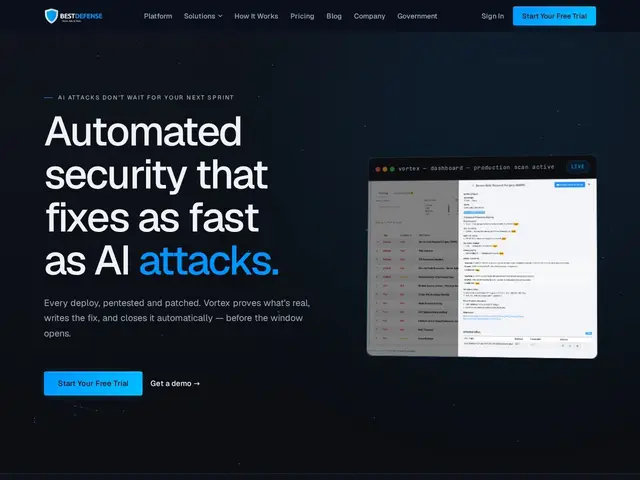
Description
Most companies get a real security audit once or twice a year, but they ship code every week — so the gap between what's tested and what's actually running in production keeps growing. Traditional scanners flood teams with alerts, most of which turn out to be false alarms, which trains everyone to ignore them. BestDefense tries to fix that by acting like a hacker that never sleeps: it attacks your live application after every deploy, actually exploits the vulnerabilities it finds to prove they're real, and then writes a code fix for a developer to review.
BestDefense is a continuous, AI-driven penetration testing platform aimed at startups, SMBs, MSPs and lean engineering teams that can't afford a full-time security staff. It runs exploit chains against real attack classes — SQL injection, authentication bypass, SSRF, privilege escalation — using graph-based analysis to guide the AI toward genuinely vulnerable code paths rather than guessing. Each finding goes through a validate-and-reverify loop, and every closed issue produces a timestamped evidence record mapped to SOC 2, ISO 27001, PCI DSS, NIST or CMMC requirements, which is useful when an auditor asks for proof rather than a promise. It integrates with GitHub, GitLab, Jira, Jenkins, Slack, AWS and Azure, and is priced by attack surface: $340/month for a small team with 2 targets, up to $3,650/month for 25 targets, with custom Enterprise pricing above that.
💬 Our review
The short version: BestDefense is worth a look if your security testing currently happens once a year (or not at all) and you want something closer to real-time coverage without hiring a pentesting team.
The execution-based validation is the real selling point — it doesn't just flag a theoretical SQL injection, it actually runs the exploit, which cuts the false-positive noise that makes teams tune out static scanners like generic SAST tools. Auto-generated, stack-aware fix PRs also shorten the usual find-to-patch gap significantly. At $340/month for a 2-target starter plan, it's genuinely accessible for a small startup, though costs scale fast — $3,650/month at 25 targets is enterprise-level spend, and you'll want to compare that against dedicated pentest-as-a-service vendors or a part-time security consultant before committing. It's not a replacement for a full manual pentest before a major compliance audit, but as continuous coverage between those audits, it fills a real gap that most lean teams currently leave open.
💰 Pricing
📊 Global score
🤖 AI-enriched data
Starter $340/mo (2 cibles), Growth $1 560/mo (10 cibles), Pro $3 650/mo (25 cibles), Enterprise sur devis
Pros
Valide les failles par exécution réelle de l'exploit, pas juste par détection statique — beaucoup moins de faux positifs
Génère des correctifs (pull requests) adaptés à la stack, pas juste un rapport
Preuves d'audit horodatées mappées SOC 2 / ISO 27001 / PCI DSS / NIST / CMMC
S'intègre à GitHub, GitLab, Jira, Jenkins, Slack, AWS, Azure
Cons
Le prix grimpe vite au-delà du plan Starter — $3 650/mo à 25 cibles
Ne remplace pas un vrai audit pentest manuel avant une certification majeure
Date de fondation non communiquée
Positionné pour des équipes déjà techniquement matures, moins pour les tout premiers pas en sécu