Lanesurf
A voice AI that calls dozens of truck drivers at once to negotiate a load's price, so a freight broker gets a booked truck in minutes instead of working the phone all day.
🔗 Visit Lanesurf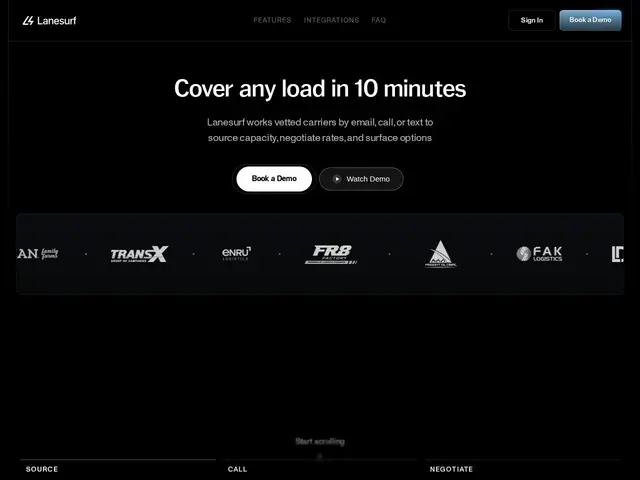
Description
Booking a truck to move a shipment usually means a human broker calling carrier after carrier, negotiating rates one conversation at a time, until someone says yes — slow, repetitive work that doesn't scale past how many calls one person can make in a day. Lanesurf replaces that manual calling with an AI that can talk to dozens of carriers simultaneously, the way a large team of junior brokers would, but automatically.
Lanesurf's voice AI handles inbound and outbound carrier calls, emails and texts in parallel, negotiating rates across many conversations at once and vetting carrier compliance before booking. It remembers context from prior conversations (lane details, quoted rates, compliance status) so it doesn't repeat itself call to call, and integrates with existing TMS platforms, load boards and CRMs, with onboarding typically under two weeks. Founded in 2025 by two IIT Delhi-trained engineers with prior Fortune 500 supply-chain experience, and backed by Y Combinator, Lanesurf doesn't publish pricing — it's sold through a sales conversation rather than self-serve signup, typical for enterprise logistics software.
💬 Our review
The short version: Lanesurf replaces the most repetitive part of a freight broker's job — calling carrier after carrier to negotiate a rate — with an AI that can run that same conversation with dozens of truckers at once.
The core idea is sound and the space is genuinely new: voice AI negotiating real-world logistics deals in parallel is a meaningfully different approach than a load board or a TMS's built-in matching. The company's own performance numbers (60-80% of loads booked via AI-sourced capacity, 8-10% better buy rates, 4+ hours saved per rep per day) are self-reported and not independently audited, so treat them as a starting point for your own pilot rather than a guarantee. Because pricing isn't published, you can't comparison-shop against a traditional TMS or a load board like DAT/Truckstop.com without a sales call — reasonable for enterprise logistics software, but it does mean more upfront diligence before you know if it fits your budget.
💰 Pricing
📊 Global score
🤖 AI-enriched data
Pas de tarification publique — vente commerciale directe, typique du logiciel logistique entreprise
Pros
Appelle et négocie avec des dizaines de transporteurs en parallèle, pas un par un
Mémoire contextuelle des conversations précédentes (tarifs, conformité)
Intégration avec les TMS, load boards et CRM existants
Fondateurs avec expérience concrète en supply chain Fortune 500, soutenu par YC
Cons
Tarification non publique, nécessite un appel commercial
Chiffres de performance auto-rapportés, non audités indépendamment
Marché US uniquement à ce stade
Produit jeune (fondé 2025), peu de recul à long terme