Fleetline
An AI dispatcher for trucking companies — it looks at every driver, load and rule at once and works out the best assignment plan, instead of a human juggling spreadsheets and gut instinct.
🔗 Visit Fleetline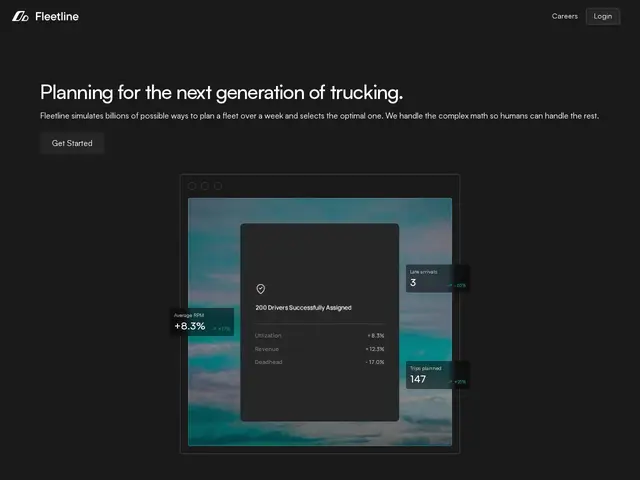
Description
Dispatching a trucking fleet means constantly re-solving a puzzle: which driver takes which load, given hours-of-service limits, driver preferences, and last-minute changes — usually done by a human dispatcher relying on experience and a lot of manual adjustment. Fleetline replaces that manual juggling with software that can actually simulate many possible plans and pick the best one, faster than a person could.
Fleetline ingests load, driver and ELD (electronic logging device) data, then uses an LLM-enhanced optimization engine to simulate billions of scheduling scenarios and deliver load assignments and route plans that respect hours-of-service and regulatory constraints. It aggregates loads across multiple brokers and the spot market, forecasts customer demand, detects predictive issues like delays or breakdowns before they happen, and includes an AI chat assistant for dispatch queries. The company reports roughly 50% less planning time, 14-25% higher fleet revenue and 12% better driver utilization, with a typical deployment timeline of about 65 days. Founded in 2025 by Saurav Kumar and Veer Juneja (previously at Meta and NVIDIA), Fleetline is Y Combinator-backed (S25) with a disclosed $500K seed round; pricing is not publicly available.
💬 Our review
The short version: Fleetline aims to replace a dispatcher's spreadsheet-and-experience approach with an AI that actually simulates the full scheduling problem before recommending a plan.
Its pitch — LLM-enhanced optimization reacting to real-time disruptions rather than a fixed rule-based algorithm — is a genuine technical step up from older fleet software, and having engineers with Meta/NVIDIA backgrounds building the optimization core is a reasonable signal of technical depth. The company's own numbers (50% less planning time, 14-25% more fleet revenue) are self-reported and should be verified against your own fleet's data during a pilot rather than taken at face value. As with Lanesurf in the same YC batch, no public pricing means you can't comparison-shop against established players like Samsara or Motive without a sales conversation, and being a 2025-founded company means there's limited independent track record yet outside its own case studies.
💰 Pricing
📊 Global score
🤖 AI-enriched data
Tarification entreprise non publique ; déploiement type ~65 jours
Pros
Simule des milliards de scénarios avant de recommander un plan, pas un algorithme figé
Prend en compte les contraintes réglementaires (heures de service, ELD) automatiquement
Détection prédictive des problèmes (retards, pannes) avant qu'ils n'arrivent
Fondateurs avec expérience technique forte (ex-Meta, ex-NVIDIA), soutenu par YC
Cons
Tarification non publique, nécessite un contact commercial
Chiffres de gain (revenu +14-25%, temps de planification -50%) auto-rapportés
Entreprise jeune (fondée 2025), peu de recul indépendant
Marché US uniquement à ce stade