OpenMarkdown
OpenMarkdown is a tiny, instant-opening notes app that stores everything as plain text files on your computer — and it's built so an AI assistant like Claude can read and edit the same file right alongside you.
🔗 Visit OpenMarkdown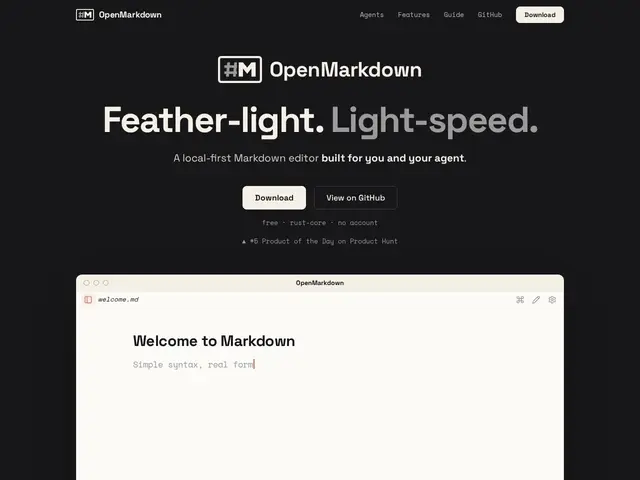
Description
Most note-taking apps trade speed and simplicity for cloud sync and lock-in — your notes live in someone else's database, and opening the app takes a few seconds you feel every single time. OpenMarkdown goes the other way: a native app with a cold start under one second, storing everything as plain .md files on your own disk, with no account or database required.
OpenMarkdown offers three editing modes (live preview, source, reading), a command palette (cmd+p), a CLI tool for terminal access, and multi-language support. Its standout feature is agent-native collaboration: because files are plain Markdown and it supports MCP, AI tools like Claude, ChatGPT and Gemini can read and edit the same notes you're working in, rather than you copy-pasting content back and forth. It's open source (51 GitHub stars), built with a native Rust core, cross-platform (macOS, Windows, Linux), and reached #5 Product of the Day on Product Hunt.
💬 Our review
The short version: OpenMarkdown is for someone who wants Notion-style note-taking speed without Notion's cloud dependency, and specifically for people who already collaborate with AI agents on their notes and want that to be seamless rather than copy-paste.
The local-first, plain-Markdown storage decision is the right one for a tool competing on speed and simplicity — no database sync overhead, and your notes remain readable and portable forever even if the app disappears. Agent-native MCP support is a genuinely timely feature: as more people work alongside AI assistants day to day, having your notes be directly readable and editable by those tools (rather than manually pasted in) removes real friction. Being free with no commercial tier at all is unusual and worth watching — it's great for users now, but raises the open question of how the project sustains itself long-term. The trade-off versus Notion or Obsidian is ecosystem: no plugins marketplace, no cloud sync built in, and a much smaller community to lean on if something doesn't work as expected.
💰 Pricing
📊 Global score
🤖 AI-enriched data
Entièrement gratuit, open source, aucun palier payant identifié
Pros
Démarrage ultra-rapide (<1 seconde)
Fichiers Markdown bruts, aucun verrouillage
Collaboration native avec les agents IA via MCP
Entièrement gratuit et open source
Cons
Pas de synchronisation cloud native
Pas d'écosystème de plugins comme Obsidian
Modèle de pérennité du projet incertain (100% gratuit)