Vibe OnCall
An AI pager that tries to investigate and fix the problem itself before waking up an on-call engineer at 3am.
🔗 Visit Vibe OnCall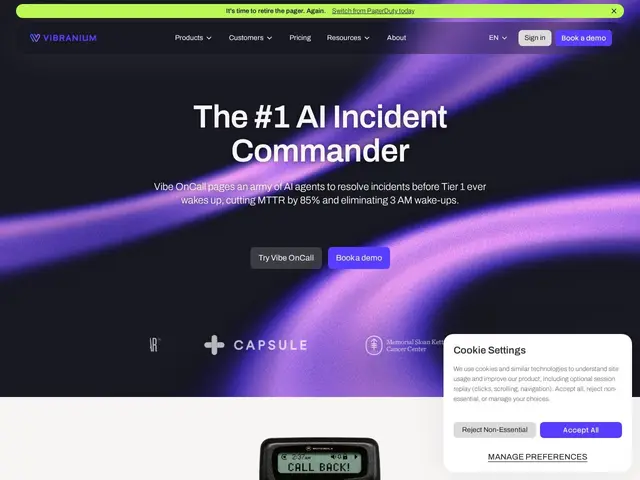
Description
Getting paged at 3am for a server outage usually means groggily digging through logs to figure out what broke. Vibe OnCall, by Vibranium Labs, puts an AI in front of that process: it validates the alert, gathers context from your tools, and tries to diagnose (and sometimes fix) the issue before it ever reaches a human's phone.
Vibe OnCall is an AI-native incident response and on-call platform positioned as a PagerDuty/Opsgenie alternative. It integrates with Slack, Teams, Jira, ServiceNow, Datadog and PagerDuty, uses specialized AI agents to investigate incidents end-to-end, supports autonomous auto-remediation with human approval gates, and automatically generates post-mortems and updates a shared knowledge base. It's SOC 2 compliant and offers self-hosting for teams with stricter data requirements.
💬 Our review
The short version: if your on-call rotation is drowning in false-positive pages and manual triage, Vibe OnCall is trying to replace that toil with an AI that does the first pass of investigation itself.
Its pitch against PagerDuty and Opsgenie is price (claimed half the cost) plus a genuinely different workflow — auto-remediation with approval gates rather than just routing an alert to a human. The free Basic tier (up to 5 users) makes it low-risk to trial against your existing paging tool during a migration window (they claim under 72 hours, with 12 months free running in parallel). The real question mark is the 85% MTTR reduction claim, which is a company-reported number, not independently audited — treat it as a marketing ceiling, not a guarantee, and pilot on lower-stakes services first. No public GitHub and no disclosed launch date also means you're trusting a young company with production incident data.
💰 Pricing
📊 Global score
🤖 AI-enriched data
Basic free (up to 5 users), Enterprise custom pricing; claims ~half the price of PagerDuty/Opsgenie, 12 months free running in parallel during migration
Pros
Free tier for small teams (up to 5 users)
Auto-remediation with human approval gates, not just alert routing
Automatic post-mortem generation and knowledge base updates
SOC 2 compliant, self-hosting available
Fast, supported migration path from incumbents (<72h claimed)
Cons
85% MTTR reduction is a company-reported claim, not independently verified
No public GitHub repo — closed source
No disclosed launch date or company track record
Enterprise pricing not transparent (custom quote)