Kelviq
A billing service that handles global sales tax, payments and usage-based pricing for SaaS and AI companies, so they don't have to build that plumbing themselves.
🔗 Visit Kelviq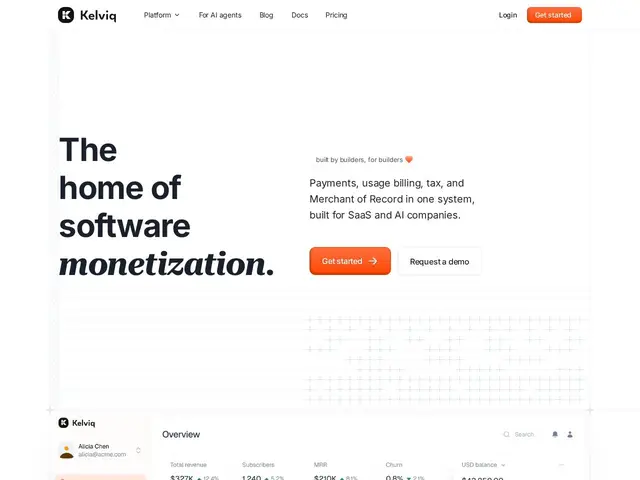
Description
Selling software worldwide means dealing with sales tax rules in over a hundred countries, currency conversion, fraud, and — for AI products — figuring out how to bill per token or per API call. Kelviq packages all of that into one service a company plugs in instead of building in-house.
Kelviq is a merchant-of-record (MoR) billing platform for SaaS and AI companies, bundling payments, checkout, global tax compliance (VAT/GST across 100+ countries), subscriptions, real-time usage metering (API calls, AI tokens, compute units), license keys, digital delivery, and dynamic feature entitlements into a single system with typed SDKs (TypeScript, React, Node, Python). As MoR, Kelviq assumes legal liability for tax and regulatory compliance across the markets it serves.
💬 Our review
The short version: Kelviq is aimed at SaaS and AI companies that don't want to build billing, tax and usage-metering infrastructure themselves, particularly ones billing by API call or token rather than flat subscriptions.
Its pitch directly against Paddle (a well-established MoR competitor) is usage-based billing built specifically for AI-native pricing models — metering tokens and compute units in real time is not something every MoR does well. The lack of public pricing is a real gap: MoR platforms typically charge a percentage of transaction volume plus fees, and without that number visible, you can't compare total cost against Paddle, Stripe Billing, or Lemon Squeezy without booking a demo first. If you're a smaller company just wanting simple subscriptions, this is likely more infrastructure than you need — it's built for AI/SaaS companies with genuinely complex usage-based pricing.
💰 Pricing
📊 Global score
🤖 AI-enriched data
Pricing not public; based on demo/contact-sales, typical MoR platforms take a percentage of transaction volume plus fixed fees
Pros
Merchant of Record — assumes global tax/compliance liability
Real-time usage metering built for AI pricing (tokens, compute units)
Typed SDKs across TypeScript, React, Node, Python
Bundles license keys, digital delivery and feature entitlements in one system
Cons
No public pricing — must book a demo to get a quote
Overkill for simple flat-subscription businesses
No disclosed launch date or company track record
Harder to comparison-shop against Paddle/Stripe without a number