OpenSpec
Open-source framework that makes an AI coding agent write a shared spec of what it's building and why before touching any code, so teams stay aligned as agents write more of the codebase.
🔗 Visit OpenSpec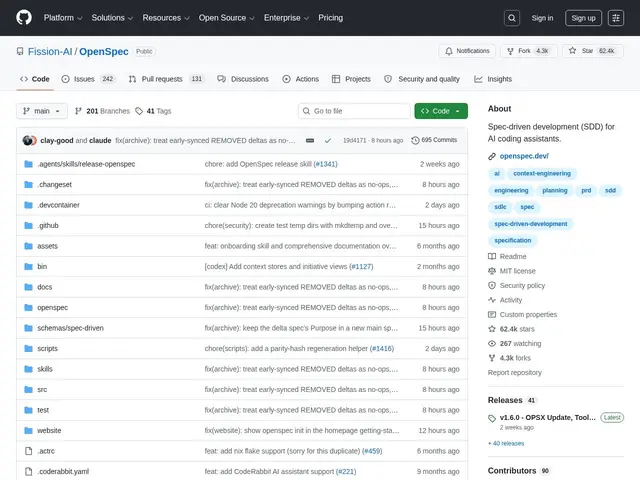
Description
When an AI coding assistant just starts writing code from a quick prompt, it's easy for a team to lose track of why a change was made, or for two people (or two AI agents) to build conflicting versions of the same feature without realizing it. OpenSpec adds a simple, free layer on top of any AI coding agent: before code gets written, the agent (or developer) has to lay out a short spec — what's being built, why, and how — that the whole team can read and approve first.
OpenSpec enforces a three-phase workflow (propose, apply, archive) and stores specs directly in the repository, organized by capability, with "delta" tracking that marks exactly what's new or modified versus the existing system — useful specifically for adding features to established ("brownfield") codebases rather than greenfield projects. It's free, open source under the MIT license, requires no API keys or MCP server of its own, and works across 25+ AI coding tools including Claude Code, Cursor, GitHub Copilot and Windsurf. Since launching from Y Combinator's W26 batch, it has grown to roughly 52,000-62,000 GitHub stars, putting it among the most widely adopted tools in the spec-driven-development category alongside GitHub's own Spec Kit and BMAD-METHOD.
💬 Our review
The short version: OpenSpec is a free way to force a "write down the plan before the AI writes the code" habit onto any AI coding agent your team already uses, and it's been adopted fast enough (tens of thousands of GitHub stars in months) to suggest it's solving a real, widely felt problem.
The genuinely useful design choice is being tool-agnostic and lightweight — rather than a full framework you adopt wholesale, OpenSpec drops a spec folder into an existing repo and works with whichever coding agent a team already uses, which lowers the switching cost to roughly zero versus a heavier competitor like AWS Kiro. Its focus on brownfield projects (delta-tracking exactly what changes in an existing system, rather than assuming a blank slate) addresses a gap that spec-driven tools built for greenfield demos often miss, since most real engineering work is adding to something that already exists. Being free, open source, and requiring no API keys of its own (you still pay for whatever AI agent you're driving it with) makes the actual cost of trying it essentially zero. The one number worth a second look before quoting it elsewhere: reported GitHub star counts for OpenSpec vary meaningfully across sources (from roughly 27,000 to 62,000 depending on when and where it was measured) — independent verification directly against the GitHub repository confirmed the figure is genuinely large and not fabricated, but exact counts should be treated as a snapshot in a fast-moving, still-growing project rather than a fixed fact. Against GitHub's own Spec Kit (larger, backed by GitHub directly) and BMAD-METHOD (a more prescriptive, heavier methodology), OpenSpec's pitch is being the lightest-weight, fastest-to-adopt option of the three.
💰 Pricing
📊 Global score
🤖 AI-enriched data
Free and open source (MIT license). No cost beyond whatever AI coding agent/API you use alongside it. Installed via npm.
Pros
Free, open source (MIT), works with 25+ existing AI coding tools
Lightweight — no new API keys or MCP server required
Purpose-built for brownfield projects with delta tracking
Rapid, verified adoption (tens of thousands of GitHub stars) since its YC W26 launch
Cons
Reported star counts vary noticeably across sources — treat as a moving snapshot, not a fixed number
A process/discipline tool, not a code generator — still requires the team to actually follow the spec workflow