Zaro
A workspace where a small team describes what they want automated in plain English, and it builds an internal tool or agent that pulls together the company's own scattered data (email, Slack, notes) to do it.
🔗 Visit Zaro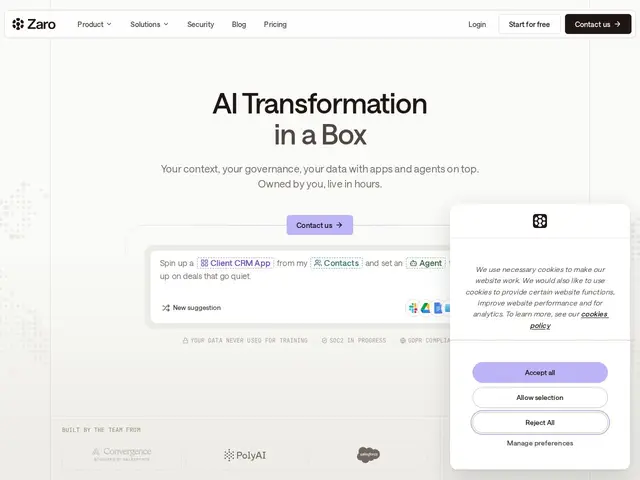
Description
Small teams drown in repetitive operational work — chasing leads, compiling reports, handing off tasks — and the tools to automate it usually require either coding skills or a patchwork of Zapier-style connections between apps. Zaro instead lets a team describe the outcome they want in a sentence, and it builds a working agent or app that pulls context automatically from the company's own tools like Gmail and Slack, keeping itself updated as those sources change.
Zaro is an AI operations platform for lean teams and solo operators, built around 'context infrastructure' that integrates scattered company tools into a single working environment. Distinctive features include automatic daily updates from connected sources, a manual control layer letting users see and steer exactly which context an agent uses, and conflict detection that surfaces contradictions between data sources rather than silently picking one. Pricing is credit-based and pay-per-use rather than per-seat, aimed at founders and ops leads managing multiple disconnected tools without deep technical resources.
💬 Our review
The short version: Zaro is for a small, non-technical team drowning in busywork who wants one prompt to turn into a working internal tool, not a Zapier flowchart to configure by hand.
The conflict-detection feature is a genuinely thoughtful detail — most automation tools silently pick a data source when two disagree, and surfacing that contradiction instead is the kind of design choice that prevents an agent confidently acting on stale or wrong information. Credit-based, no-per-seat pricing is also a sensible fit for the target user: a 3-person ops team doesn't want to pay per-seat for a tool three people occasionally poke at. The honest caveat: this is a young company (launched publicly June 2026, ranked #3 on Product Hunt that day) built by founders coming from Convergence/Salesforce agent work — promising pedigree, but no long track record yet, and the site itself returned a 403 on direct access during research, making it hard to verify claims beyond the Product Hunt listing. Compared to established no-code automation like Zapier or newer no-code agent builders like Lindy, Zaro's bet is that 'one prompt, self-updating context' beats manually wiring workflows — worth trying given the credit-based low commitment, but go in expecting an early-stage product, not a mature platform.
💰 Pricing
📊 Global score
🤖 AI-enriched data
Credit-based pay-per-use, no per-seat charges. 3-month 50% discount offered at launch. Spend designed to be predictable and capped.
Pros
One-prompt agent/app building from natural language, no manual workflow wiring
Conflict detection surfaces contradictions instead of silently guessing
Credit-based pricing fits occasional, small-team use better than per-seat
Automatic daily context updates from connected tools
Cons
Young company, launched publicly June 2026, no long track record
Site returned 403 during research — limited independent verification beyond Product Hunt
Competes with far more established Zapier for core automation use cases