Scytale
A service that gets a software company ready for its first security certification (like SOC 2) and keeps it that way automatically, instead of a founder spending months chasing screenshots for an auditor.
🔗 Visit Scytale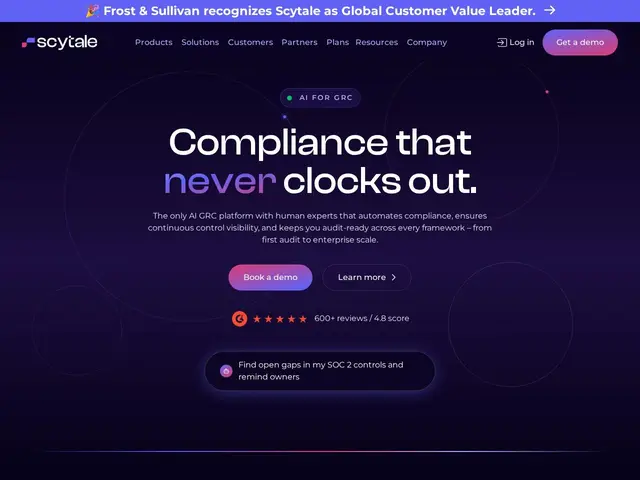
Description
Getting a SOC 2 or ISO 27001 certificate usually means weeks of manually collecting evidence — screenshots of settings, access logs, policy documents — to prove to an auditor that a company actually follows good security practices. Scytale automates that evidence collection continuously, so instead of a compliance fire drill once a year, the proof stays current automatically and the audit becomes a formality rather than a scramble.
Scytale is a GRC (Governance, Risk and Compliance) automation platform covering 80+ frameworks including SOC 2, ISO 27001, HIPAA, PCI DSS and GDPR. It includes an AI agent for continuous control monitoring, a public-facing Trust Center to showcase compliance status to prospects, vendor risk management, user access reviews, AI-generated security questionnaire responses, and integrations for penetration testing and on-premises systems. It's aimed at startups pursuing their first audit through to enterprises managing multi-framework compliance.
💬 Our review
The short version: Scytale turns the annual compliance scramble into a continuously-maintained status, which matters most the first time a startup needs SOC 2 to close an enterprise deal.
The AI-generated security questionnaire responses are a genuinely useful time-saver — enterprise sales cycles are full of repetitive vendor security questionnaires, and automating first-draft answers from your existing control evidence removes real busywork. The public Trust Center is a smart sales tool too, letting prospects self-serve your compliance posture instead of a back-and-forth email chain. The honest caveat: pricing is entirely opaque — no dollar figures anywhere, demo required — which makes it hard to compare against Vanta or Drata, the two most common alternatives in this exact space, both of which are similarly demo-gated but have more visible market presence and reviews. For a startup chasing its first SOC 2 to unblock a sale, any of the three (Scytale, Vanta, Drata) will likely solve the immediate problem — the real decision driver is which one's specific framework coverage and integrations match your stack, which you'll only know after getting quotes from at least two.
💰 Pricing
📊 Global score
🤖 AI-enriched data
Tiered (Startup: Build Starter/DFY/Stronger; Enterprise: Scale/Enterprise) with framework add-ons. No public dollar amounts — requires a demo/contact.
Pros
80+ compliance frameworks covered (SOC 2, ISO 27001, HIPAA, PCI DSS, GDPR)
AI-generated first-draft answers for security questionnaires
Public Trust Center to self-serve compliance status to prospects
Continuous monitoring instead of annual evidence scramble
Cons
No public pricing anywhere — demo required to get a number
Less market visibility/reviews than Vanta or Drata in the same category
Framework fit varies — worth comparing quotes before committing