Rainforest Pay
Payment processing that a software company can build directly into its own product — so instead of sending customers to a separate checkout page, the SaaS platform itself handles the payment and keeps a cut.
🔗 Visit Rainforest Pay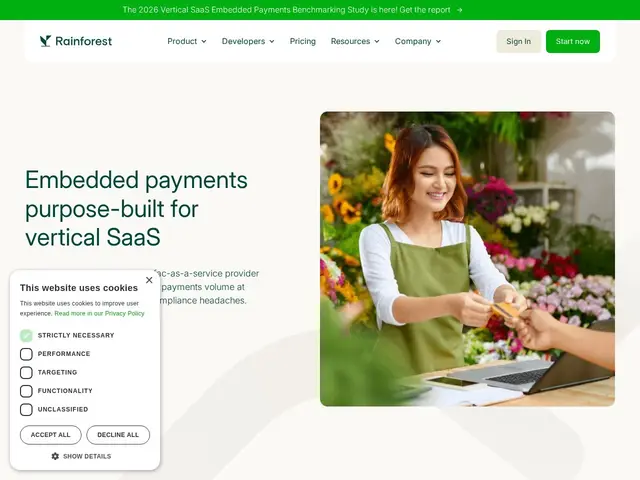
Description
Many software platforms that serve other businesses (say, a scheduling app for salons) eventually want to process the actual payments their customers make, rather than just pointing them to Stripe or Square separately — that's real revenue left on the table. Rainforest Pay lets a SaaS platform embed payment processing directly into its own product, becoming the payment processor itself and keeping a share of every transaction.
Rainforest Pay is a payments-facilitator-as-a-service (payfac-as-a-service) platform purpose-built for vertical SaaS, as opposed to competitors built on top of traditional acquirer relationships. It offers real-time merchant onboarding, support for cards, ACH, Apple Pay, PayPal and physical terminals, next-day funding, embedded reporting and chargeback handling, and a low-code white-labeled component library alongside a full API with sandbox testing. Pricing is transparent and interchange-plus: roughly $0.20-0.30 per card transaction or 0.20-0.30% by volume depending on monthly spend, $0.20 per ACH item, and no PCI DSS fees.
💬 Our review
The short version: Rainforest Pay is for a SaaS company that wants to become its customers' payment processor, not just point them at Stripe — and it's built to be embedded rather than bolted on.
The 'purpose-built, not acquirer-based' architecture claim matters in practice: many payfac platforms are wrappers around a traditional acquirer relationship with the associated latency and inflexibility, while a ground-up build usually means faster merchant onboarding and more control over the embedded experience. Transparent, published interchange-plus pricing is also unusually forthright for this space — plenty of payment infrastructure providers hide behind 'contact sales,' so being able to actually see per-transaction costs before a sales call is a real point in its favor. The honest caveat: becoming a payment facilitator is a meaningful compliance and engineering commitment regardless of which vendor you pick — this isn't a drop-in Stripe Checkout button, it's infrastructure for a platform serious about owning the payment flow. For a vertical SaaS company already sending meaningful payment volume through a third party and losing that margin, the math likely favors moving to embedded payments; for an early-stage product without payment volume yet, this is premature.
💰 Pricing
📊 Global score
🤖 AI-enriched data
Card: $0.20-0.30/transaction or 0.20-0.30% by volume (tiered by monthly spend up to $25M+). ACH/Payouts: $0.20/item. 3DS: $0.31/attempt. Disputes: $15/item. EMV terminal: $11.25/month. No PCI DSS fees.
Pros
Purpose-built payfac architecture, not a wrapper on an acquirer
Transparent published interchange-plus pricing
Real-time merchant onboarding and next-day funding
Supports cards, ACH, Apple Pay, PayPal and physical terminals
Cons
Becoming a payfac is a real compliance/engineering commitment, not a quick integration
Premature for early-stage products without real payment volume yet
Fewer public case studies/market presence than Stripe Connect