Agno
An open-source Python framework and runtime for building AI agents — it gives them memory, tools and access to 30+ model providers through one API, plus a control panel (AgentOS) to run them in production.
🔗 Visit Agno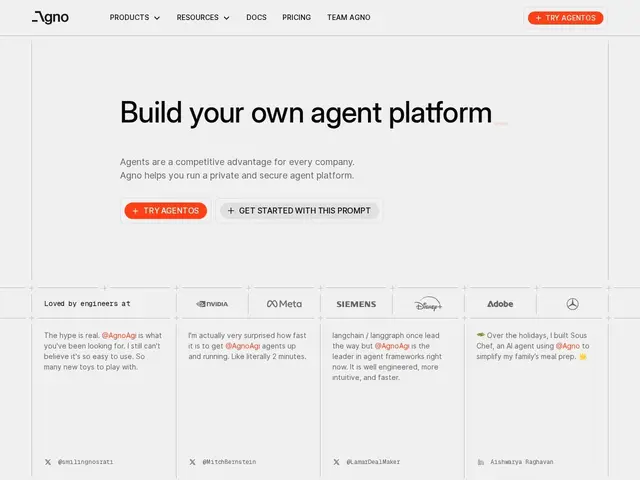
Description
An 'AI agent' is a program that uses a large language model to actually get things done — calling tools, remembering context and taking several steps toward a goal rather than just answering one question. Building one from scratch means wiring up models, memory, tools and monitoring yourself. Agno is a toolkit that provides those building blocks so developers can assemble reliable agents without reinventing the plumbing each time.
Agno (formerly Phidata) is a Python agent framework paired with a high-performance runtime and 'AgentOS', a web control plane for running agents in production. It exposes 30+ model providers (OpenAI, Anthropic, Google and more) through a single API, and can host agents built not only with Agno but also with the Claude Agent SDK, LangGraph and DSPy on the same infrastructure. It handles memory, knowledge/RAG, session monitoring and logging, deploys on AWS, GCP, Railway, Kubernetes or air-gapped environments, and the core framework is open source under Apache 2.0.
💬 Our review
The short version: Agno is a strong pick when you want an open-source, Python-first way to build agents and a real control plane to operate them, without being locked to a single model vendor.
Two things make it stand out in a crowded field: the unified interface across 30+ model providers (so switching from, say, OpenAI to Anthropic is a config change, not a rewrite), and AgentOS, which addresses the part most frameworks ignore — actually running, monitoring and managing agents in production rather than just building them in a notebook. Being genuinely open source (Apache 2.0) and able to run air-gapped is a real advantage for enterprises with data-residency constraints. The honest caveats: the agent-framework space is extremely crowded and fast-moving (LangGraph, the OpenAI and Claude Agent SDKs, CrewAI and Pydantic AI all compete here), so betting on any one framework carries churn risk; Agno is Python-only, so JavaScript/TypeScript teams will look elsewhere (Mastra, Vercel AI SDK); and while the framework is free, the managed AgentOS jumps to 150 dollars a month, so weigh whether you need the hosted control plane or will self-host it.
💰 Pricing
📊 Global score
🤖 AI-enriched data
Open-source framework and local control plane free. Pro 150/mo (hosted AgentOS, 1 connection, 4 seats; +30/mo per seat, +95/mo per connection). Enterprise custom (SSO/RBAC, dedicated support, self-hosted).
Pros
One unified API across 30+ model providers — no vendor lock-in
AgentOS control plane actually runs/monitors agents in production, not just builds them
Genuinely open source (Apache 2.0) and can run air-gapped
Runs agents from Agno, Claude Agent SDK, LangGraph and DSPy on one runtime
Cons
Very crowded, fast-moving space — framework churn risk
Python-only; JS/TS teams will look elsewhere
Managed AgentOS jumps to 150 dollars a month