Trigger.dev
An open-source platform for writing long-running background jobs and AI-agent workflows in TypeScript or Python, with automatic retries, queuing and scaling — and no timeouts, so tasks can run as long as they need.
🔗 Visit Trigger.dev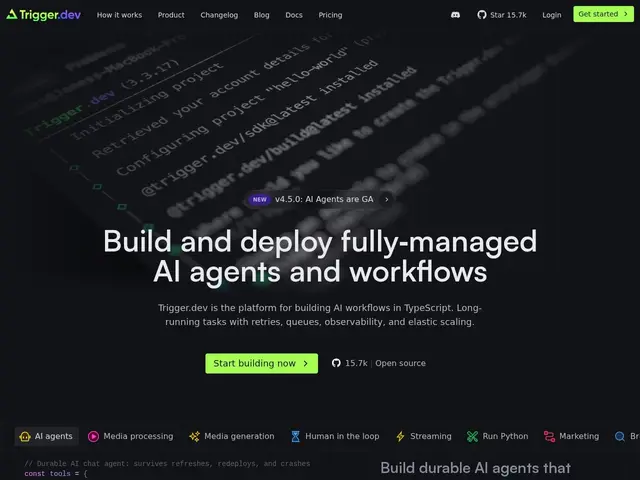
Description
Serverless functions are great until a job takes too long and gets cut off, or fails halfway with no clean way to resume. Trigger.dev is built for exactly that kind of work — long or complex background tasks — letting you write them as ordinary code while it handles queuing, retries, scheduling and scaling, without the usual serverless time limits.
Trigger.dev is a fully-managed — and open-source (Apache 2.0), self-hostable — background-jobs and workflow platform. You write tasks in TypeScript or Python, deploy them to Trigger's infrastructure, and get durable cron schedules with no timeout, automatic retries, atomic versioning, real-time task streaming to the frontend and built-in observability. It includes an AI-agent framework with tool calling and human-in-the-loop, multi-region workers, static IPs and concurrency controls, and is used in production by companies including Cal.com, Supabase and Magic Patterns.
💬 Our review
The short version: Trigger.dev is the option to reach for when your background work is genuinely long-running or agent-like and you want a platform that owns execution — while still being fully open source and self-hostable if you ever need to leave the cloud.
The no-timeout, long-running model is its clearest differentiator: tasks that would be awkward or impossible on plain serverless (multi-minute jobs, agent loops, big batch processing) run naturally, and real-time streaming of task progress to the UI is a nice touch for user-facing workflows. Full Apache-2.0 open source and self-hostability give it an edge over Inngest, whose server is source-available (SSPL), if avoiding lock-in matters to you. The honest caveats: because you deploy tasks to Trigger's own worker infrastructure, it is more of a 'platform' with a little more setup than dropping in a lightweight SDK; the pay-as-you-go compute-per-second pricing is flexible but harder to predict than a flat plan; and it overlaps heavily with Inngest, so the choice often comes down to feel — platform-owns-execution versus SDK-in-your-app — rather than raw capability.
💰 Pricing
📊 Global score
🤖 AI-enriched data
Pay-as-you-go compute per second plus per-run. Monthly plans: Free (5 dollars credits), Hobby 10/mo, Pro 50/mo, Enterprise custom. No charge for waits over 5 seconds or for dev-environment runs.
Pros
No timeouts — long-running jobs and agent loops run naturally
Fully open source (Apache 2.0) and self-hostable
Real-time task streaming to the frontend + built-in observability
Proven in production (Cal.com, Supabase, Magic Patterns)
Cons
More of a 'platform' with a bit more setup than a drop-in SDK
Compute-per-second pricing is flexible but harder to predict
Overlaps heavily with Inngest — choice is often about feel