ElectricSQL
A sync engine that keeps a live copy of your Postgres data on each user's device, so apps feel instant and keep working offline instead of waiting on the network for every action.
🔗 Visit ElectricSQL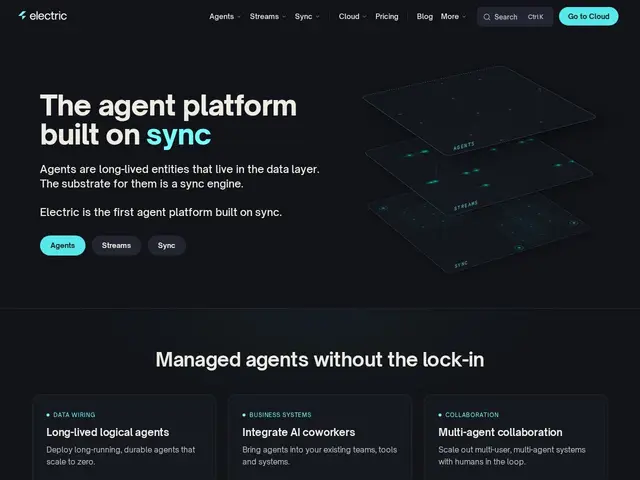
Description
Most apps talk to a database over the internet every time you click something — which is why they feel sluggish on a weak connection and often break entirely when you are offline. Electric (formerly ElectricSQL) takes a different route: it keeps a live copy of exactly the data each user needs right on their device, and quietly keeps it in sync with the main Postgres database in the background. The result is software that feels instant and still works on the subway.
Electric syncs subsets of a Postgres database — defined as 'Shapes' — down to local clients over plain HTTP, handling partial replication, caching and real-time updates so you don't have to build a custom sync layer. The core sync engine is open source (Apache 2.0) and self-hostable, while Electric Cloud is a managed, globally distributed delivery network billed per million writes. It works with any existing Postgres database and any frontend framework, and the project has increasingly positioned itself around powering data for AI agents and Notion/Figma-style collaborative apps that need durable, resumable state. Note the project rebranded from 'ElectricSQL' and now lives at the electric.ax domain.
💬 Our review
The short version: Electric solves one genuinely hard problem well — syncing a slice of Postgres to the device and keeping it live — so you don't have to hand-roll offline support, caching and real-time updates yourself.
The 'Shapes over HTTP' design is a real strength: because sync rides on standard HTTP and CDN caching instead of a long-lived websocket per user, it scales more cheaply than realtime backends that hold a connection open for everyone. Being open source with a self-hostable core is a meaningful hedge against lock-in versus closed sync services. The honest caveats: local-first is still an emerging paradigm, so you are adopting patterns (conflict handling, partial replication, local reads) that are less battle-tested than a plain request/response API; the recent rebrand and lean toward 'AI agent data' means some older tutorials and the electric-sql.com address now redirect; and Electric only syncs Postgres, so it is not a fit if your source of truth is another database. Pricing is usage-based (around 1 dollar per million writes pay-as-you-go, cheaper on the 249-per-month Pro tier), which is fair but worth modelling against your real write volume before committing.
💰 Pricing
📊 Global score
🤖 AI-enriched data
Open-source core is free to self-host. Electric Cloud is usage-based: ~1 USD per 1M writes pay-as-you-go, 0.90/1M on Pro (249/mo), 0.80/1M on Scale (1,999/mo); reads and concurrent users unlimited.
Pros
Open-source, self-hostable core (Apache 2.0) — real hedge against lock-in
Sync rides on plain HTTP + CDN caching, so it scales cheaper than websocket-per-user backends
Works with any existing Postgres database and any frontend framework
Handles partial replication, caching and real-time updates for you
Cons
Local-first is still an emerging paradigm — patterns are less battle-tested than plain APIs
Only syncs Postgres; not a fit if your source of truth is another database
Recent rebrand/redirect (electric-sql.com -> electric.ax) means some docs/tutorials point elsewhere