Velum Labs
Tool that watches every query hitting a company's data warehouse, catches bad data before it reaches a dashboard, and automatically writes the rule that prevents it from happening again.
🔗 Visit Velum Labs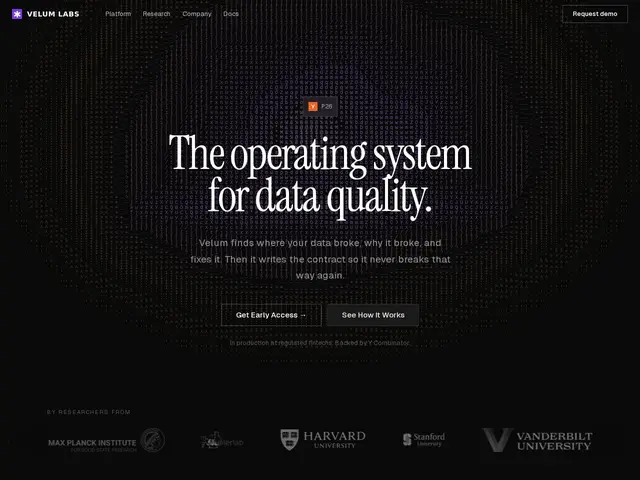
Description
A dashboard showing the wrong number doesn't announce itself as wrong — someone downstream just makes a bad decision based on it, and by the time anyone notices, tracing back to which query or data change actually caused it can take a data team days. Velum Labs watches data as it moves and gets queried across a company's whole stack, catches quality problems as they happen, and traces the exact chain of dependencies back to the root cause — then writes an enforceable rule (a "data contract") so the same problem can't silently recur.
Velum Labs continuously monitors query patterns and data distributions, builds a live dependency graph so a data issue can be traced back through its lineage rather than guessed at, proposes automated fixes with generated migrations, and creates data contracts directly from observed production query traffic. It integrates with dbt, CI/CD pipelines and orchestration tools, and is aimed at data teams — particularly at regulated companies like financial institutions — where a data quality error isn't just embarrassing, it can be a compliance problem.
💬 Our review
The short version: Velum Labs is trying to catch bad data before it reaches a dashboard, and trace exactly why it happened, rather than the more common pattern of discovering a data problem only after someone downstream already acted on wrong numbers.
The live dependency-graph tracing is the feature that matters most here — most data-observability tools tell you a metric looks anomalous; fewer tell you which specific upstream query or schema change actually caused it, which is the difference between an alert and an actual fix. Generating enforceable data contracts directly from real production query traffic (rather than a data team having to write and maintain them by hand) is a genuinely practical shortcut for keeping quality rules current as a data stack evolves. The honest caveat: this is an extremely early (YC P26), tiny company with no public pricing yet and an early-access-only customer base — a data team evaluating it should treat it as a promising but unproven bet rather than an established alternative to Monte Carlo or Soda, and validate its specific claims about regulated-industry deployments directly with the company rather than from the public site alone.
💰 Pricing
📊 Global score
🤖 AI-enriched data
Not publicly disclosed; early access program, targeting enterprise data teams.
Pros
Live dependency-graph tracing to the actual root cause of a data quality issue
Automatically generates enforceable data contracts from real production query traffic
Integrates with dbt, CI/CD and orchestration tools
Focused on regulated-industry use cases where data errors carry compliance risk
Cons
Extremely early-stage (YC P26), tiny team, no public pricing
Unproven at broad scale compared to established data-observability vendors
Some open-source repos found in research are minor components, not the core product