Sardine
Fraud-detection system that scores a payment as risky or safe while it's happening — checking the device, behavior and identity behind it — instead of catching fraud only after the money's already gone.
🔗 Visit Sardine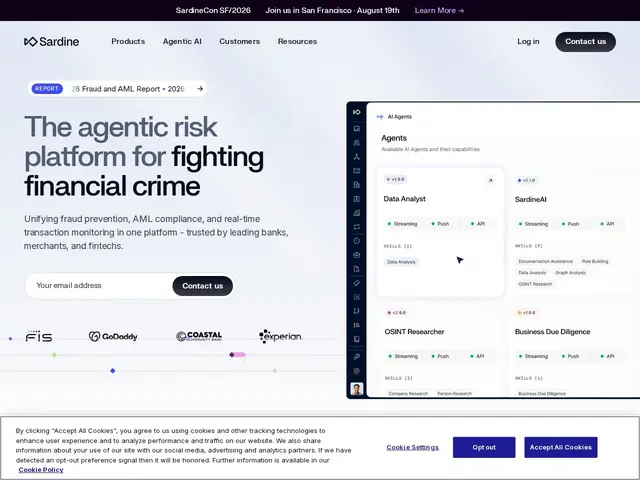
Description
By the time a fraudulent payment gets flagged after the fact, the money's often already moved and hard to recover — the only real defense is catching it during the transaction itself. Sardine watches signals like how someone's device behaves, subtle patterns in how they type or move a mouse, and identity verification data, then scores the risk of a payment in real time as it's happening, so a fintech or bank can block or challenge it before it completes rather than investigating after the loss.
Sardine covers device intelligence and behavioral biometrics (branded "True Piercing"), real-time fraud scoring across ACH, wire, SEPA, RTP, FedNow and Zelle payment rails, global KYC/KYB identity verification, account-takeover and bot detection, sanctions screening, and newer "agentic" AI features that automate fraud and AML alert reviews and investigations. It shares fraud-signal intelligence across a consortium of its customers, and counts major fintechs and financial infrastructure companies (Nubank, Intuit, GoDaddy, FIS, Deel) among its 450+ enterprise customers.
💬 Our review
The short version: Sardine's pitch is scoring fraud risk during the payment itself rather than after, and its adoption across a genuinely broad range of payment rails (ACH, wire, RTP, FedNow, Zelle) plus real fintech-infrastructure customers (Nubank, Intuit, FIS) suggests this isn't just a narrow point solution but something operating at real transaction volume.
The fraud-intelligence consortium — sharing risk signals anonymously across Sardine's customer base — is a genuinely valuable network effect specific to fraud detection: a device or behavioral pattern flagged as risky at one company becomes useful signal for every other company on the network, which a single-customer fraud model can't replicate. Layering identity verification (KYC/KYB) and sanctions screening alongside pure transaction fraud detection means a fintech can potentially consolidate multiple compliance vendors into one platform rather than running separate tools for each function. The honest caveat: several of Sardine's most impressive scale statistics (985 million consumers protected, 4.92 billion transactions processed, 6.2 billion devices profiled) are large enough that the underlying methodology deserves a direct question during evaluation, and its widely-cited sub-100ms latency figure wasn't found directly on the company's own site during this research — worth confirming current performance benchmarks directly rather than repeating older third-party figures. Against Unit21, which focuses more on the no-code investigation/case-management side of fraud and AML operations, Sardine leans harder into the real-time transaction-scoring layer itself — many financial institutions end up using both together rather than choosing one over the other.
💰 Pricing
📊 Global score
🤖 AI-enriched data
No public pricing; enterprise sales, contact required.
Pros
Scores fraud risk during the payment itself, across a broad range of payment rails
Fraud-intelligence consortium creates a network effect across its customer base
Consolidates fraud detection, KYC/KYB and sanctions screening in one platform
450+ enterprise customers including major fintech infrastructure (Nubank, Intuit, FIS)
Cons
Some headline scale statistics (billions of transactions/devices) deserve a direct methodology question
Widely-cited sub-100ms latency figure wasn't confirmed directly on the company's own current site
No public pricing, fully custom enterprise sales