Devin (by Cognition)
AI described as an autonomous software engineer — it doesn't just suggest code, it plans a task, writes the code, tests it, and can open the pull request itself.
🔗 Visit Devin (by Cognition)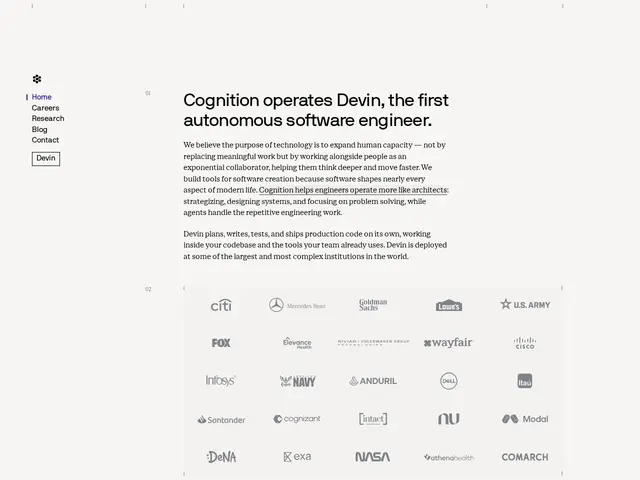
Description
Most AI coding tools work turn by turn: you ask, it suggests, you decide what to do next. Devin was built to run further ahead on its own — given a task, it plans the approach, writes and tests the code across a whole project, reviews its own work with visual QA, and can carry a piece of work from a ticket all the way to an opened pull request, checking in with a human at key decision points rather than every single step.
Devin handles autonomous multi-file coding, testing and deployment, automated PR review with visual QA, large-scale code migration and refactoring, auto-generated documentation and system diagrams, issue triage and bug fixing, and multi-repository project management, integrating with 50+ existing tools (GitHub, Linear, Slack, Datadog, AWS). It's available via cloud, desktop app, CLI, or a Windows VM, and Cognition acquired Windsurf — a well-known agentic IDE — in July 2025, expanding its footprint from a standalone agent into IDE-level tooling as well.
💬 Our review
The short version: Cognition's valuation trajectory — from a March 2024 launch to a $26 billion valuation by mid-2025 — reflects how seriously investors are betting on "autonomous software engineer" as a real category, not just an incremental coding-assistant feature, and enterprise partnerships with names like Goldman Sachs and Mercedes-Benz suggest that bet is landing with genuinely risk-averse buyers, not just startups.
The Windsurf acquisition is a meaningful strategic move: rather than staying purely a cloud-agent product, Cognition now also owns a popular IDE, giving it both the "autonomous agent working independently" experience and the "AI assistant inside your editor" experience under one roof, which few competitors can claim simultaneously. The honest caveat: this is a genuinely different (and higher-stakes) product than a suggestion-based coding assistant — letting an agent autonomously write, test and open PRs across multiple files and repos means mistakes can be more consequential and harder to catch mid-stream than with a tool that suggests one function at a time, and its specific efficiency claims (a Nubank case study citing 8x engineering time efficiency, 20x cost savings on migration scope) are single-customer results, not guaranteed for every codebase or team. Pricing isn't published, requiring a sales conversation for anything beyond the free trial — appropriate to evaluate carefully with a real, bounded pilot task before trusting it with broad autonomous authority over a production codebase.
💰 Pricing
📊 Global score
🤖 AI-enriched data
Free trial available; specific paid tiers not published, enterprise sales contact required.
Pros
Runs further autonomously than a suggestion-based coding assistant — plans, codes, tests, and can open a PR
Owns both a standalone autonomous agent and a popular IDE (Windsurf, acquired 2025)
Enterprise partnerships with risk-averse buyers (Goldman Sachs, Mercedes-Benz)
Handles large-scale code migration/refactoring, not just small suggestions
Cons
Higher-stakes autonomy means mistakes can be more consequential and harder to catch mid-task
Efficiency claims (8x, 20x) are single-customer case studies, not guaranteed universally
No published pricing, requires a sales conversation