BentoLabs AI (Bento)
Monitoring layer for long-running AI agents that notices when an agent quietly drifts off its instructions or starts failing silently, and suggests a fix before it causes real damage.
🔗 Visit BentoLabs AI (Bento)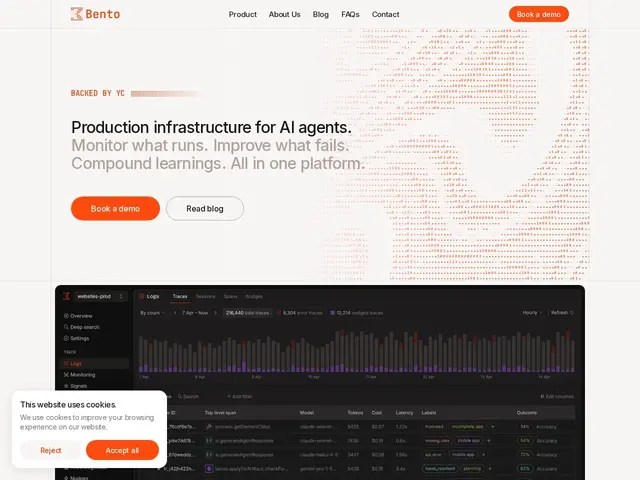
Description
A short-lived AI agent that answers one question either works or it doesn't — you find out immediately. A long-running agent that keeps operating for hours or days can drift away from what it was actually supposed to do without ever throwing an error, quietly doing the wrong thing while looking like it's still working. Bento watches agents over their whole run, catches that kind of silent drift or failure, and — going further than just alerting — learns from accumulated production traces to improve the agent automatically over time.
Bento uses OpenTelemetry-native distributed tracing, detects behavioral drift from an agent's original system prompt or goal, groups related failures into natural-language alert rules and incidents, offers evaluation scoring across offline tests, CI and live production traffic, and maintains reusable "Artifacts" (skills, subagents, tools) with versioned, diffable, reversible change tracking. It's aimed specifically at teams running agentic systems that operate autonomously for extended periods, not simple one-shot chatbot interactions.
💬 Our review
The short version: Bento is solving a problem specific to long-running agents — not "did this one response work" but "has this agent silently drifted off-course over the last several hours of autonomous operation" — which is a harder and less-discussed failure mode than the single-turn evaluation most LLM tooling focuses on.
The self-learning layer, which compounds improvements from accumulated production traces rather than requiring a human to manually retune the agent each time, is the most technically ambitious part of the pitch — if it holds up, it means an agent genuinely gets better at its job over time rather than staying static until someone manually intervenes. Versioned, reversible change tracking on the agent's tools and skills ("Artifacts") is a sensible safety net for a system making autonomous changes to itself. The honest caveat: this is an extremely early (YC P26) company, no public pricing, and its most eye-catching performance claims (a reported 2.6x higher score on the ARC-AGI-3 benchmark, 34% cheaper per successful outcome) come from the company's own April 2026 blog post rather than independent benchmarking — worth a direct conversation to understand methodology before weighing those numbers heavily in a purchase decision. It's a genuinely different angle from Agnost AI (which analyzes finished production conversations for user-facing failure patterns) — Bento is more focused on runtime drift detection during an agent's actual operation.
💰 Pricing
📊 Global score
🤖 AI-enriched data
Not published; demo required via booking link.
Pros
Focused specifically on long-running agent drift and silent failure, not just single-turn evaluation
Self-learning layer aims to compound improvements from production traces automatically
OpenTelemetry-native distributed tracing
Versioned, diffable, reversible tracking of agent skills/tools
Cons
Extremely early-stage (YC P26), no public pricing
Headline performance claims are from the company's own unverified blog post
Overlaps in category with Agnost AI though the specific angle (runtime drift vs. finished-conversation analytics) differs