Attio
CRM built with a flexible, spreadsheet-like data model instead of rigid sales-pipeline fields, with AI agents that can prospect and advance deals on their own around the clock.
🔗 Visit Attio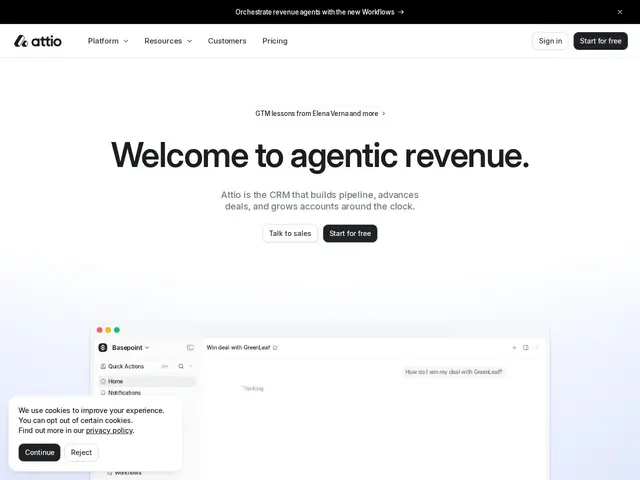
Description
Traditional CRMs like Salesforce were built decades ago around rigid pipeline stages and fixed fields, which made sense for a certain kind of sales process but forces every company into the same shape whether it fits or not. Attio was built the opposite way: its data model is flexible like a spreadsheet, so a company defines exactly what it wants to track, and on top of that flexible base, AI agents can work continuously — finding prospects, advancing deals, updating records — without someone manually driving every step.
Attio's "Universal Context" layer automatically logs emails, calls and product usage against the right record without manual data entry, its AI agents handle prospecting and lead enrichment around the clock, it includes call intelligence with meeting recording and analysis, real-time reporting and forecasting, and a full developer platform (SDK, API, MCP) for teams wanting to build custom integrations or connect it to tools like Claude, Slack, Notion and Linear.
💬 Our review
The short version: Attio is the modern-CRM bet that a flexible, user-defined data model plus AI agents doing continuous background work beats forcing every company into Salesforce's decades-old fixed pipeline structure, and its adoption by technically sophisticated companies (Linear, Notion, OpenAI, Railway) is a real signal that bet resonates with teams who'd notice if it didn't actually save time.
The "Universal Context" auto-logging feature addresses one of the most chronic CRM problems directly — reps not updating records because manual data entry is tedious, which makes a CRM's data go stale and unreliable over time; automatically capturing emails, calls and usage against the right record removes that friction at the source. Having a genuine developer platform (SDK, API, MCP) rather than treating integrations as an afterthought fits its positioning toward technical, product-led companies specifically, distinguishing it from CRMs built primarily for traditional enterprise sales orgs. The honest caveat: several of its most eye-catching adoption statistics (2.6M MCP calls/month, 400M API calls/week, 30,000+ customers) weren't independently verified during research and should be treated as company-reported figures, and — like any AI-agent-driven CRM — the value of "agents prospecting and advancing deals 24/7" depends heavily on how well-configured those agents are for your specific sales process, not something to assume works well out of the box without setup effort.
💰 Pricing
📊 Global score
🤖 AI-enriched data
Plus €39/mo/user (€31 annual). Pro €93/mo/user (€74 annual). Enterprise custom. Credit system (100-2,500 credits/mo by tier) alongside seat pricing.
Pros
Flexible, user-defined data model instead of rigid fixed pipeline fields
Universal Context auto-logs emails/calls/usage without manual data entry
AI agents work continuously on prospecting and deal advancement
Genuine developer platform (SDK, API, MCP), adopted by technical companies (Linear, Notion, OpenAI)
Cons
Several headline adoption statistics are company-reported, not independently verified
AI agent effectiveness depends on proper configuration for your specific sales process
Seat-plus-credit pricing model requires understanding both dimensions to budget accurately