Tractable
AI that looks at photos of a damaged car or house and writes up a repair estimate in seconds — the kind of assessment that normally takes a human adjuster days.
🔗 Visit Tractable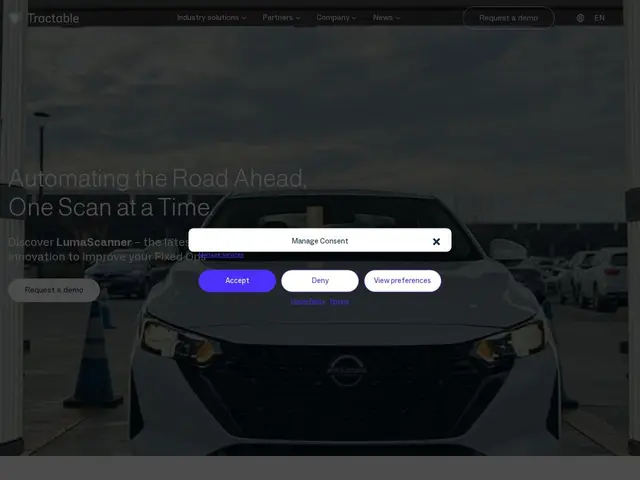
Description
After a car accident or storm damage, someone has to physically inspect the damage, work out what parts are affected, and write up a repair estimate — a process that can take days and creates a real bottleneck for both the insurer and the person waiting on their claim. Tractable trained AI on hundreds of millions of real damage photos to do that assessment automatically: send it pictures of the damage, and it identifies exactly what's affected and produces a full repair estimate — parts, labor, paint — in seconds instead of days.
Tractable's computer vision analyzes vehicle and property damage images down to the pixel level, attaches a certainty score to each assessment factoring in image quality and damage visibility, automatically identifies affected parts for repair or salvage decisions, and plugs into an insurer's existing claims-management system via API. It's used by major insurers across the US, UK, Japan and Europe (Aviva, Tokio Marine, Admiral, Covéa) and partners with Verisk, a major insurance-data provider, to offer AI property-damage estimates.
💬 Our review
The short version: Tractable has been doing exactly this — AI damage assessment for insurance claims — since 2014, longer than most AI startups have existed at all, and its adoption by major insurers across four continents (Aviva, Tokio Marine, Admiral) is a strong signal that the technology holds up under real regulatory and financial scrutiny, not just in a demo.
The pixel-level certainty scoring is the detail that matters most for insurance specifically: rather than a black-box "this will cost $X" output, Tractable's assessments come with a confidence level tied to image quality and damage visibility, which gives an adjuster a concrete signal for when to trust the automated estimate versus escalate to a human review — a meaningfully more honest design than presenting every AI output with equal confidence. The Verisk partnership (a major, established insurance-data company) for property-damage estimates specifically is a notable expansion beyond Tractable's original auto-damage focus, and a credibility signal in its own right given Verisk's position in the industry. The honest caveat, consistent with the whole insurtech category: Tractable doesn't publish specific accuracy benchmarks or false-positive/negative rates, and claimed efficiency gains ("10x reduction in claim time," "90% touchless" cited by one customer, Admiral Seguros) are customer-specific results rather than guaranteed outcomes for every insurer's claim mix — worth validating in a pilot against your own claims data, same caution warranted for any vendor's headline statistic in this space.
💰 Pricing
📊 Global score
🤖 AI-enriched data
No public pricing; enterprise sales, demo request required.
Pros
Over a decade of operating history (since 2014) in AI damage assessment specifically
Pixel-level certainty scoring gives adjusters a concrete confidence signal, not a black-box output
Adopted by major insurers across the US, UK, Japan and Europe
Verisk partnership extends the technology into property damage, beyond its original auto focus
Cons
No published accuracy benchmarks or false-positive/negative rates
Efficiency claims are customer-specific results, not guaranteed for every claim mix
No public pricing, enterprise sales only