Agnost AI
Analytics tool that reads real conversations your AI chatbot or voice agent had with users and automatically writes a code fix when it spots a recurring failure pattern.
🔗 Visit Agnost AI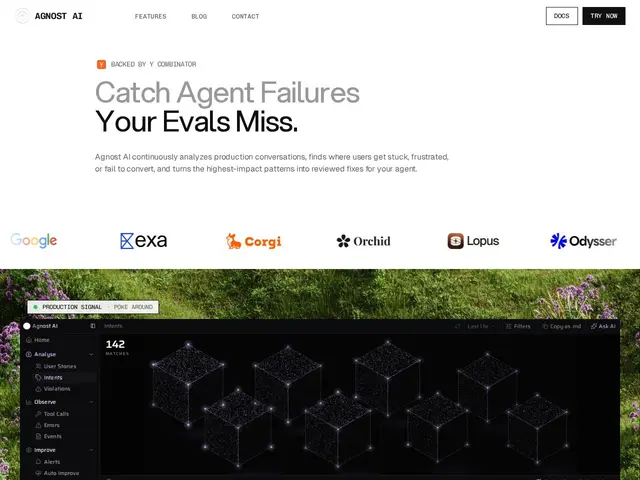
Description
Most teams building an AI chatbot or voice agent only find out it's failing users when someone complains, or not at all — the agent doesn't crash, it just gives an unhelpful answer and the user quietly leaves. Agnost AI reads through the actual conversations an agent has had in production, automatically spots patterns like someone getting frustrated, repeating themselves, or asking for something the agent can't do, and then goes a step further than just reporting the problem: it opens a pull request with a suggested fix to the agent's prompt or tools.
Agnost AI clusters production conversations into categories like broken workflows, repeated retries, setup friction, and churn risk, lets a team query that data in plain language, integrates natively with OpenTelemetry, and works across both text and voice conversations regardless of which LLM or agent framework is powering them. It's aimed at any team building and scaling AI agents that wants visibility into how those agents actually perform once real users start talking to them, not just how they score on a pre-launch test set.
💬 Our review
The short version: Agnost AI is solving a different problem than LLM eval tools like Braintrust or Confident AI — those help you test an agent before it ships; Agnost AI watches what actually happens after it ships, in real conversations with real users, which is a genuinely distinct and often-neglected part of the AI product lifecycle.
The auto-generated pull request is the feature that separates this from a plain analytics dashboard — instead of just telling a team "12% of conversations show frustration signals," it proposes a concrete prompt or tool change addressing the pattern, turning an observability signal directly into an actionable code change a developer reviews rather than a report someone has to manually act on. Being LLM- and framework-agnostic (works regardless of which model or agent framework you're using) matters for teams that switch models frequently or run a mixed stack, a real practical advantage over a tool tied to one specific provider's ecosystem. The honest caveat: this is a very new (2025-founded), tiny (2-person) YC S26 company — its named customer list (Google among smaller AI teams) is a positive signal, but the underlying open-source claim found during research applies to a component with essentially no GitHub activity (1 star), so don't take an "open source" label at face value here; the real product is clearly the hosted analytics service, not a self-hostable open-source tool. Pair it with a pre-launch eval tool (Braintrust, Confident AI) rather than treating it as a replacement — Agnost AI's value is specifically in the post-launch, real-conversation layer those tools don't cover.
💰 Pricing
📊 Global score
🤖 AI-enriched data
Starter: Free (1,000 messages/mo, 7-day retention). Pro: $499/mo (100,000 messages/mo, 90-day retention). Enterprise: custom (unlimited messages, custom retention, audit logs, SLAs).
Pros
Analyzes real post-launch production conversations, not just pre-launch test sets
Automatically opens a pull request with a suggested fix, not just a report
Works across text and voice, regardless of LLM or agent framework
Named enterprise customer (Google) among smaller AI-native teams
Cons
Very new, tiny (2-person) company with a short track record
An "open source" claim found in research applies to a near-empty component, not the core hosted product
Complements rather than replaces a pre-launch eval tool