Suki
AI clinical assistant that takes voice commands and ambient conversation to write medical notes, suggest billing codes, and answer clinical questions hands-free.
🔗 Visit Suki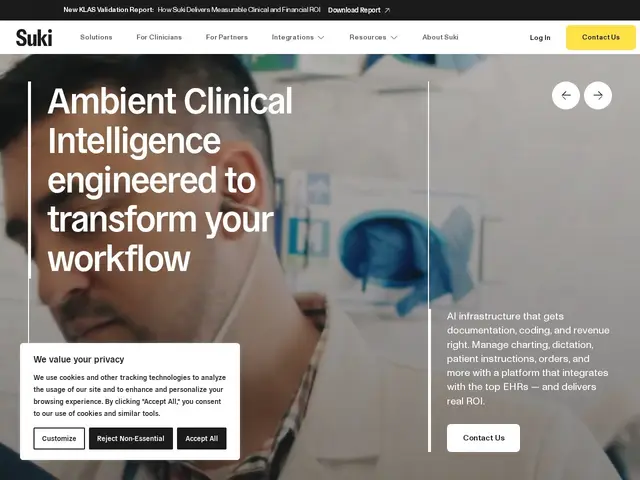
Description
Typing a medical note after every patient is tedious, but so is trusting an AI to silently write the whole thing without any way to correct it in the moment. Suki splits the difference: a doctor can talk to it directly — "Suki, add that the patient reports mild fever" — while it also passively listens and drafts documentation, so it works as either an active assistant you direct or an ambient scribe running quietly in the background.
Suki covers ambient conversation capture, voice-driven note editing and problem-based charting, automated ICD-10/HCC/CPT medical coding suggestions, revenue-cycle optimization support (E/M level automation), and clinical reasoning/Q&A, with integrations into Epic, Oracle Health, athenahealth and MEDITECH. It's cross-platform (iOS, Android, desktop) and reports usage across 400+ healthcare systems and partners, backed by over $165M in funding from investors including Venrock, First Round and Zoom Ventures.
💬 Our review
The short version: Suki's real differentiator is being voice-command-driven, not just ambient-listening — a clinician can actively direct it ("add this," "remove that") mid-conversation rather than only reviewing and editing an AI-generated draft afterward, which suits doctors who want more direct control over documentation as it happens.
That active-voice-command layer, combined with revenue-cycle features (automated E/M coding, billing optimization), pushes Suki slightly more toward the administrative/billing side of the problem than Abridge or Nabla, which lean more purely into ambient note generation. This is a real, useful distinction for a practice whose biggest pain point is billing accuracy and coding compliance rather than just note-writing speed. The honest caveat, flagged directly during research: parts of Suki's own homepage displayed what looked like template placeholder metrics (0% improvement figures) rather than filled-in real numbers — worth confirming any specific performance claim directly with a Suki sales rep rather than trusting whatever's currently on the public site, and cross-checking against independent sources like KLAS ratings rather than the vendor's own case studies. As with the rest of this category, pricing is enterprise-only and undisclosed, so a real cost comparison against Abridge or Nabla requires getting quotes from all three for your specific health-system size.
💰 Pricing
📊 Global score
🤖 AI-enriched data
No public pricing; enterprise sales, direct sales contact required for a quote.
Pros
Active voice-command control, not just passive ambient listening
Strong revenue-cycle features: automated ICD-10/HCC/CPT coding, E/M level automation
Cross-platform: iOS, Android, desktop
Broad EHR integration (Epic, Oracle Health, athenahealth, MEDITECH)
Cons
Some public homepage metrics appeared as unfilled placeholders during research — verify any specific claim directly with sales
No independent third-party ranking as strong as Abridge's KLAS position
Enterprise-only pricing, no public comparison point