Nabla
AI ambient assistant that listens during patient visits and automatically drafts clinical notes and medical codes across 50+ specialties and dozens of languages.
🔗 Visit Nabla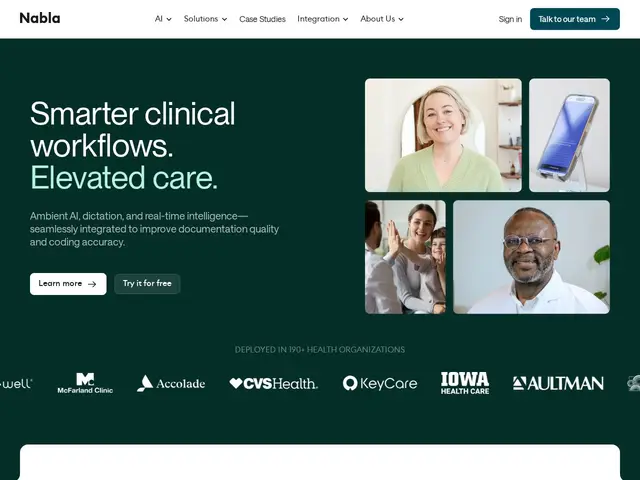
Description
A clinic in one country and a clinic in another shouldn't need entirely different tools just because doctors and patients there speak a different language — but most AI medical-scribe products were built English-first, with everything else an afterthought. Nabla was designed the opposite way from early on: it listens to a patient visit and writes the clinical note automatically, in whichever of dozens of supported languages the conversation actually happened in, including mixed bilingual conversations.
Nabla covers ambient voice capture during visits, real-time clinical note generation, automated medical coding, and integrates with major EHR systems (Epic, athenahealth, Oracle/Cerner, NextGen, Greenway Health). It's used across 50+ medical specialties by more than 100,000 active clinicians at 190+ health organizations, offers a Chrome extension and mobile apps, and moved away from public per-month pricing in 2026 in favor of enterprise contracts negotiated per health-system deal.
💬 Our review
The short version: Nabla's strongest pitch is language and specialty breadth — over 50 specialties and dozens of languages including bilingual encounters — which matters more than it sounds for any health system serving a diverse patient population, a case most competitors handle less completely.
The practical advantage over an English-first tool is real: a clinic seeing patients in multiple languages doesn't need to run two separate scribe systems or fall back to manual notes for non-English visits. Broad EHR integration (Epic, athenahealth, Oracle/Cerner, NextGen, Greenway) also means it fits into more existing hospital tech stacks without custom integration work. The honest caveat is the 2026 pricing shift: Nabla used to publish per-month tiers and now sells purely through demo and contract, which makes it harder for a smaller practice to quickly compare cost against Abridge or Suki without a sales conversation — treat any specific dollar figure you find online as outdated until confirmed directly. Vendor-reported metrics (55% of users saving an hour a day, 27% burnout reduction) lack disclosed sample sizes or methodology, same caution that applies across this whole category; Abridge's independent KLAS ranking is currently a stronger outside signal of quality than anything Nabla has published to counter it, so a buyer choosing primarily on quality-in-English-speaking settings should weigh that, while a buyer with real multilingual needs gets more direct value from Nabla's specific strength.
💰 Pricing
📊 Global score
🤖 AI-enriched data
No public pricing since 2026 shift to demo/contract-only sales. Previously had public per-month tiers.
Pros
Strong multilingual support, including bilingual/mixed-language encounters
50+ medical specialties covered
Broad EHR integration (Epic, athenahealth, Oracle/Cerner, NextGen, Greenway)
100,000+ active users at 190+ health organizations
Cons
No public pricing since 2026 — demo/contract-only, harder to comparison-shop quickly
Vendor-reported efficiency/burnout metrics lack disclosed methodology
Less independently verified market-leader ranking than Abridge's KLAS position