Common Room
GTM intelligence platform that turns community activity, product usage and buying signals (job changes, website visits) into automated, AI-driven sales workflows.
🔗 Visit Common Room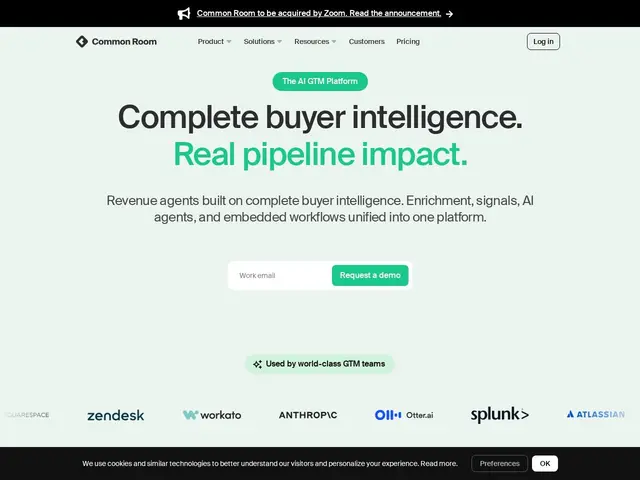
Description
A company's best sales leads often show up as small signals scattered across different tools — someone at a target account visits the pricing page, a champion changes jobs, a developer stars the GitHub repo — and by the time a human notices the pattern, the moment has passed. Common Room pulls all of those signals into one place and uses AI agents to act on them automatically, so a sales team gets notified (or a workflow fires) the moment a real buying signal appears, instead of relying on someone to spot it manually.
Common Room combines a buyer-intelligence engine ("Context360") with AI agents ("RoomieAI") that research accounts and contacts automatically, tracks signals like job changes and website visits, resolves identities across a 400M+ contact directory, and orchestrates workflows that push data and actions into Salesforce, Slack, email and browser tools. It effectively consolidates 8-10+ separate point tools (intent data, enrichment, engagement tracking, CRM automation) into one platform, and counts Anthropic, Notion, Figma, MongoDB and Databricks among its customers.
💬 Our review
The short version: Common Room's pitch is consolidation — replacing a stack of separate intent-data, enrichment, and engagement tools with one platform that connects community/product signals directly to sales action, and its adoption by companies like Anthropic and Databricks (itself technical, discerning buyers) is a meaningful endorsement.
The genuinely useful part is tying together signals that usually live in separate systems — a GitHub star, a pricing-page visit, a champion's LinkedIn job change — into one identity-resolved view of an account, then letting an AI agent (RoomieAI) act on that pattern rather than requiring a human to notice it. For a company selling developer tools or technical SaaS specifically, this fills a gap that generic CRM enrichment tools (ZoomInfo, Clay) don't cover as well, since community and product-usage signals matter more for developer-focused GTM than for traditional B2B sales. The honest caveat is pricing: starting at $2,500/month for just 5 seats and 100k contacts puts it firmly in mid-market-to-enterprise territory, not a tool a small team adopts casually, and as with any vendor-reported case study ("74% more pipeline in one quarter"), treat single-customer numbers as illustrative rather than a guaranteed outcome for your own funnel. With Orbit — its most direct historical competitor in developer-community-to-GTM signal tracking — acquired and shut down by Postman in 2024, Common Room is now the more established, safer choice in this specific niche.
💰 Pricing
📊 Global score
🤖 AI-enriched data
Essential $2,500/mo (billed annually, 5 seats, 100k contacts). Advanced and Enterprise tiers custom-priced (15/30 seats, 250k/750k contacts).
Pros
Consolidates 8-10+ separate GTM point tools into one platform
Connects community/product-usage signals (GitHub, Discord, Slack) to sales action, unusual among CRM enrichment tools
400M+ contact directory with identity resolution
Adopted by discerning technical buyers (Anthropic, Databricks, MongoDB, Figma)
Cons
Starts at $2,500/month — mid-market-to-enterprise pricing, not for small teams
Case-study numbers are single-customer claims, not guaranteed outcomes
Overlaps in scope with both intent-data and CRM-enrichment tools, evaluate against both categories