Rask AI
AI video dubbing platform that translates and voices your videos into 130+ languages while cloning the original speaker's voice and syncing lips.
🔗 Visit Rask AI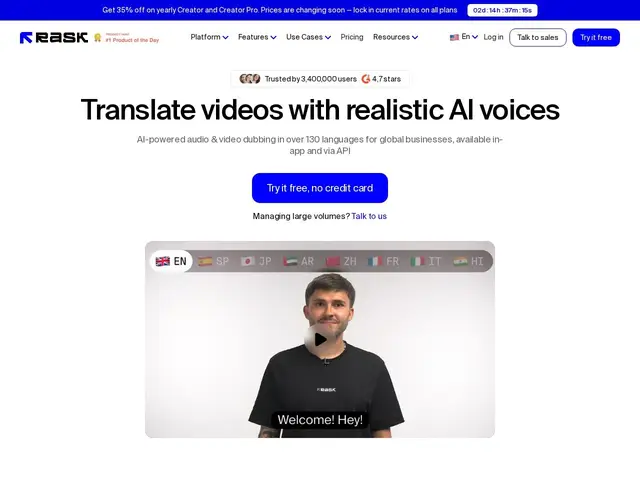
Description
Imagine recording a video once and having it instantly understood by audiences in over a hundred countries — in a voice that still sounds like the person who made it. That's what Rask AI does: it automatically translates and dubs videos, cloning the original speaker's voice and adjusting their lip movements to match the new language, so a single video can go global without hiring translators, voice actors, or editors for every version.
Rask AI is an AI dubbing and localization platform built around voice cloning (available in 32 of its 130+ supported languages) and automatic lip-sync. Beyond dubbing, it handles multi-speaker detection, speech-to-text transcription, a translation dictionary for keeping terminology consistent, and an API for teams that want to plug dubbing into their own content pipeline at scale. A built-in video editor and SRT import/export round out the workflow for teams that need to fine-tune output before publishing.
💬 Our review
The short version: if you make video content and want it understood outside your home language without assembling a translation and voice-acting team, Rask AI turns that into a mostly self-serve upload-and-wait job.
The genuinely useful part is voice cloning combined with lip-sync — most translation tools give you subtitles or a generic AI voice-over; Rask tries to preserve the original speaker's identity, which matters for creators and brands where the presenter's voice is part of the message. The API is the other differentiator: teams publishing video at real volume (course platforms, media companies) can wire dubbing into their existing pipeline instead of using the web app one video at a time. The honest trade-off is cost at scale — pricing is per-minute-processed, so a heavy publishing schedule adds up fast compared to a flat-fee editor, and voice-cloning quality, while impressive, still isn't a full substitute for professional human dubbing on premium film or TV work. Against direct competitors: HeyGen leans more into full AI avatars/presenters, CAMB.AI positions itself for broadcast-grade enterprise pipelines, and ElevenLabs' dubbing is part of a broader voice-AI suite rather than a video-first product — Rask sits closer to the everyday creator/marketing-team price point of that group.
💰 Pricing
📊 Global score
🤖 AI-enriched data
Free trial (3 min). Creator $60/mo or $396/yr (300 min/yr). Creator Pro $150/mo or $936/yr (1,200 min/yr). Business $750/mo or $6,000/yr (6,000 min/yr, $3/extra min). Enterprise custom.
Pros
Voice cloning across 32 languages combined with lip-sync
API for automating dubbing at scale in an existing pipeline
Built-in video editor plus SRT import/export for fine-tuning
Cons
Per-minute pricing scales up quickly for high-volume publishers
Voice cloning still trails professional human dubbing for premium film/TV work