3D AI Studio
Full-pipeline AI 3D asset platform — generate, remesh, texture, rig and export game-ready 3D models — with a node-based workflow builder for repeatable studio pipelines.
🔗 Visit 3D AI Studio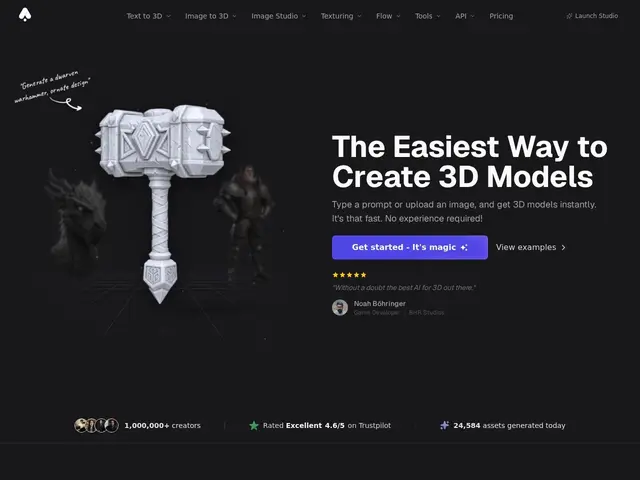
Description
A game studio doesn't need just one 3D model — it needs a repeatable process for producing dozens or hundreds of consistent assets without redoing the same manual steps every time. 3D AI Studio is built for that: beyond generating a single 3D model from a text or image prompt, it lets a team chain generation, cleanup, texturing and rigging steps together into a reusable pipeline, so the same workflow can run on the next asset automatically.
3D AI Studio covers text-to-3D and image-to-3D generation, AI texturing with PBR materials, quad remeshing for clean topology, rigging and animation AI, and a visual node-based pipeline builder called Flow for chaining these steps. It also includes a separate Image Studio for 2D image generation/editing, a shared asset library with bulk download, and API access plus team workspaces on its Pro tier, exporting to FBX, GLB, OBJ, STL, USDZ, BLEND, PLY and DAE.
💬 Our review
The short version: where Meshy is the fast single-model tool, 3D AI Studio is built for teams that need to run the same asset-generation process repeatedly and consistently — its Flow pipeline builder is the feature that actually matters for a studio rather than a solo creator.
Quad remeshing (producing clean, animation-friendly topology rather than the messy raw mesh most generative 3D tools output) is a real technical differentiator that matters specifically for game-ready assets meant to deform properly when animated — a detail casual users won't notice but that saves real rework for a technical art team. Naming Epic Games and Unreal Engine as customers, if accurate, is a meaningful adoption signal for a tool in this category, though as with any vendor-stated customer list it wasn't independently verified beyond the company's own claims. The honest trade-off versus Meshy: 3D AI Studio's credit costs and Pro tier ($99/mo) are higher, and the added workflow-building complexity (Flow, Image Studio, team workspaces) is only worth paying for if you actually need repeatable multi-step pipelines — a solo hobbyist generating occasional models will get equivalent single-asset quality from Meshy at a lower price with less to learn.
💰 Pricing
📊 Global score
🤖 AI-enriched data
Free: 1,000 credits/mo. Studio: $19/mo ($10.80/mo annual), 3,500 credits/mo. Pro: $99/mo ($59.40/mo annual), 18,000 credits/mo. One-time credit packs from $34 to $399.
Pros
Node-based Flow pipeline builder for repeatable multi-step asset workflows
Quad remeshing for clean, animation-ready topology
Wide export format support (FBX, GLB, OBJ, STL, USDZ, BLEND, PLY, DAE)
API access and team workspaces on Pro tier
Cons
Higher cost than Meshy for equivalent single-asset generation
Extra pipeline-building complexity is wasted on solo/occasional use
Customer names (Epic Games, Unreal Engine) are vendor-stated, not independently confirmed