Tonic.ai
Generates realistic fake versions of your production data — same shape and statistics, no real customer information — so developers can test against data that looks real without ever touching actual user records.
🔗 Visit Tonic.ai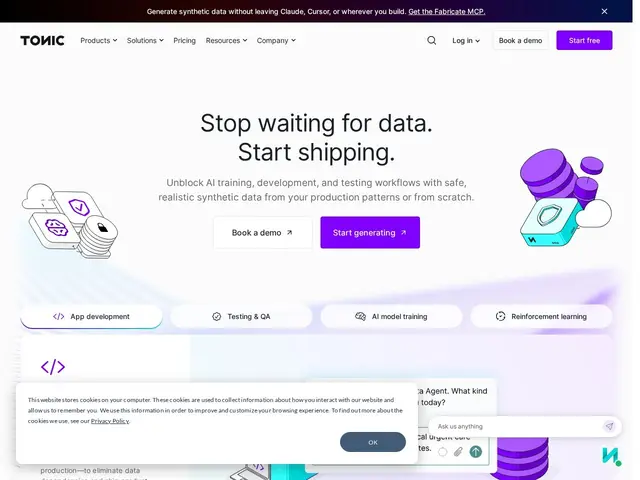
Description
Testing software against a copy of real production data is useful — it catches bugs a tiny sample dataset never would — but copying real customer records into a test environment is a privacy and compliance risk. Tonic.ai solves that by generating synthetic data that behaves statistically like your real data (same distributions, same relationships between fields) without containing any actual person's information, so a developer testing against it gets realistic conditions without the legal exposure of real data sitting in a staging environment.
Tonic.ai is a synthetic data platform spanning structured databases (Tonic Structural), fabricated data generation from scratch (Tonic Fabricate) and unstructured text de-identification (Tonic Textual). It's aimed at engineering and data teams that need dev/staging/test environments populated with production-realistic data, or need to strip PII from text before it's used for AI training or analytics. Tonic Fabricate starts free (with monthly credits) and scales to a $29/month Plus tier plus overage; Tonic Structural and Textual are usage-based or enterprise-priced, with a self-hosted option available for teams that can't send data off-premises. The company reports customers including GoFundMe, JPMorgan Chase, eBay and the NHL, and acquired the Fabricate product line in 2025 to expand its from-scratch data generation capabilities.
💬 Our review
The short version: Tonic.ai is a mature, well-funded ($35M+ raised) player solving a genuinely common pain point — dev and staging environments either running on stale toy data or, worse, a risky copy of real production data — and its multi-product spread (Structural, Fabricate, Textual) covers more of that problem than a single-purpose synthetic-data tool.
The main thing to weigh is scope: Tonic's case-study numbers (75% faster test-data generation, 8PB reduced to 1GB, and similar) are the company's own reported outcomes rather than independently audited figures, so treat them as directional rather than guaranteed for your own setup. Pricing is also fragmented across three separate products with different models (Fabricate has a visible free/paid tier, Structural and Textual lean toward custom enterprise quotes), so getting a full picture of cost requires talking to sales for anything beyond the entry tier. For teams that specifically need private, PII-free test data at the database level, Tonic.ai's specialization and enterprise customer base (JPMorgan, eBay) make it a safer bet than a general-purpose data tool; for a single quick synthetic dataset without procurement overhead, the free Fabricate tier is the more accessible entry point.
💰 Pricing
📊 Global score
🤖 AI-enriched data
Tonic Fabricate : Free ($0, crédits limités/mois), Plus ($29/mois + dépassement), Enterprise (devis). Tonic Structural et Textual : tarification à l'usage ou devis Enterprise, option self-hosted.
Pros
Couvre données structurées, génération from-scratch et dé-identification de texte en une suite
Base clients établie et financement solide ($35M+)
Option self-hosted pour les équipes ne pouvant pas envoyer leurs données hors site
Cons
Chiffres de cas clients auto-rapportés, non audités indépendamment
Pricing fragmenté sur 3 produits, difficile d'avoir une vision de coût globale sans contacter les ventes
Au-delà de Fabricate, l'essentiel du pricing est sur devis