Holistic AI
A platform that started by checking AI systems for unfair bias and has grown into a full compliance dashboard — finding AI a company didn't even know it was using, and tracking whether all of it meets legal and ethical standards.
🔗 Visit Holistic AI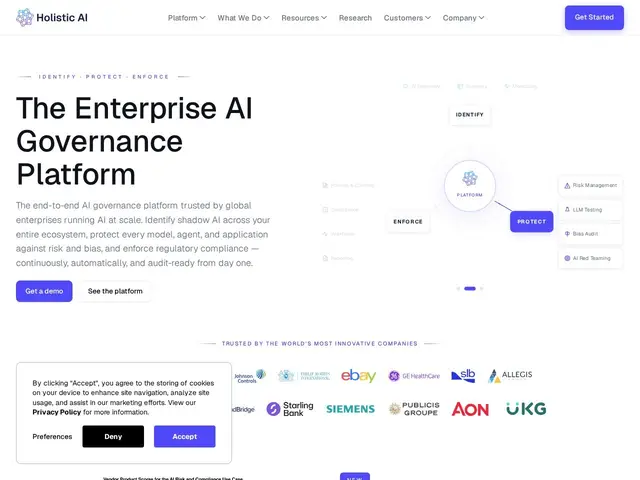
Description
Bias in AI systems — a hiring algorithm that quietly favors one group, a lending model with a blind spot — is hard to catch by manual review, and it's only one piece of the broader compliance question a company faces once AI is running across the business. Holistic AI began as a specialist in exactly that bias-detection problem and has since grown into a full governance platform, the way a security company that started with one type of audit often expands into full-spectrum risk monitoring.
Holistic AI is an AI governance platform that evolved from a bias-auditing specialist into full-lifecycle governance, including 'shadow AI' discovery (finding AI tools used inside a company without formal approval) and automated risk testing with continuous compliance monitoring. Its open-source Python library, holisticai (MIT licensed, on PyPI), remains publicly available for bias and fairness auditing, while the commercial platform adds discovery, monitoring and reporting on top. It was featured in Gartner's first-ever Magic Quadrant for AI Governance Platforms (July 2026), a notable industry validation. Pricing is enterprise-only with no public tiers — the pricing page returns no published rates, requiring direct contact with sales.
💬 Our review
The short version: Holistic AI's specific origin story — starting as a bias-auditing specialist rather than a generic compliance dashboard bolted onto AI — gives it a technical credibility edge on the fairness/bias-testing piece that broader governance platforms sometimes treat as a checkbox feature.
Its open-source holisticai Python library (MIT licensed) is a genuine, independently-usable artifact that a team can try before ever talking to sales, which is more transparency than most enterprise governance vendors offer. Its 'shadow AI' discovery feature — finding unauthorized AI tools inside an organization — addresses a real and growing problem as employees adopt AI tools faster than IT can track them. Being featured in Gartner's inaugural Magic Quadrant for this category is meaningful analyst validation, though as a first-year category the rankings themselves are less battle-tested than an established Magic Quadrant. Like its closest competitor Credo AI, pricing is entirely custom-quoted. For organizations where AI fairness and bias testing specifically is the top concern (hiring, lending, healthcare screening), Holistic AI's specialist heritage makes it a strong first call; for broader general AI governance across many use cases, it's worth comparing directly against Credo AI before choosing.
💰 Pricing
📊 Global score
🤖 AI-enriched data
SaaS Enterprise, tarification sur devis uniquement — aucun palier public affiché.
Pros
Héritage spécialiste de l'audit de biais, plus rigoureux qu'un simple bolt-on de conformité
Librairie open source holisticai (MIT) utilisable indépendamment avant tout contact commercial
Détection de 'shadow AI' — outils IA non approuvés utilisés dans l'entreprise
Présent dans le tout premier Magic Quadrant Gartner pour la gouvernance IA (juillet 2026)
Cons
Aucune tarification publique, devis obligatoire
Magic Quadrant de première année, moins éprouvé qu'une catégorie Gartner établie
Fort chevauchement fonctionnel avec Credo AI, concurrent direct