SkyPilot
Open-source tool that automatically finds and runs your AI training jobs on whichever cloud or cluster has the cheapest available GPUs.
🔗 Visit SkyPilot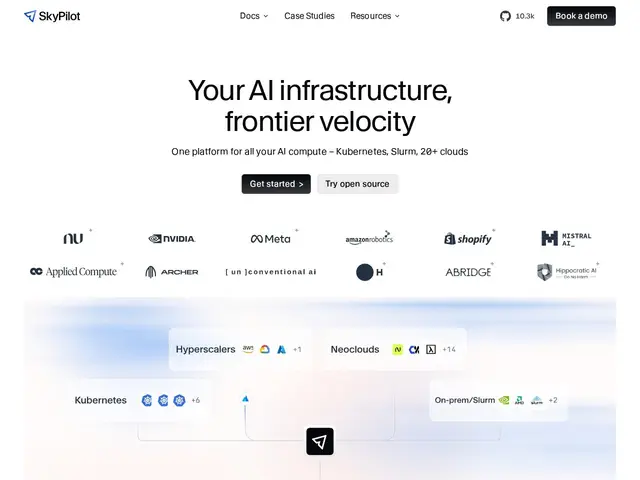
Description
GPU availability and pricing change constantly across cloud providers — one provider might be sold out of H100s this week while another has spare capacity at a lower price. Manually checking and switching between providers to chase that is tedious and easy to get wrong. SkyPilot automates the whole decision: you describe what compute you need, and it figures out where to actually run the job, across whichever cloud or cluster currently has it available at the best price.
SkyPilot is an open-source framework, born at UC Berkeley's Sky Computing Lab, for unifying compute management across Kubernetes clusters, Slurm and more than 20 cloud providers. You define a job's requirements (GPUs, memory, disk) in a simple spec, and SkyPilot handles selecting, provisioning and scheduling it for cost efficiency and GPU availability — including automatic failover if a chosen provider runs out of capacity. It adds enterprise features on top of the open-source core: SSO, role-based access control, workspaces, quota enforcement and cost reporting, plus GPU health checks with automatic remediation. Because it runs entirely within your own cloud accounts and infrastructure (bring-your-own-cloud), there's no markup on compute itself — SkyPilot is Apache 2.0 licensed and free, with roughly 10,300 GitHub stars.
💬 Our review
The short version: SkyPilot solves a real, specific pain — GPU price and availability fragmentation across clouds — and doing it as an open-source, bring-your-own-cloud tool rather than a managed marketplace means there's no markup sitting between you and the underlying provider's actual price.
It's less a competitor to RunPod, Lambda or CoreWeave than a layer that can sit on top of several of them at once, orchestrating where a job actually runs rather than being a GPU provider itself — a team could use SkyPilot to automatically shop across RunPod, a hyperscaler, and their own Kubernetes cluster for the best available price on any given day. The trade-off is that SkyPilot doesn't give you dedicated, guaranteed capacity the way CoreWeave's enterprise contracts do — it optimizes across whatever's available, which is ideal for flexible, cost-sensitive workloads and less suited to a team that needs a guaranteed large cluster for a specific training run. For teams already spread across multiple cloud accounts trying to control GPU costs, SkyPilot is worth adopting purely for the cost savings; for a single, dedicated production deployment, a direct provider relationship may be simpler.
💰 Pricing
📊 Global score
🤖 AI-enriched data
Open source (Apache 2.0), free — runs entirely within your own cloud accounts, no markup on compute.
Pros
Free and open source (Apache 2.0), no markup since it runs in your own cloud accounts
Automatically shops across 20+ clouds and Kubernetes/Slurm clusters for best price/availability
Automatic failover if a chosen provider runs out of GPU capacity
Cons
Not a GPU provider itself — you still need cloud accounts with actual capacity to draw from
No guaranteed dedicated capacity the way an enterprise contract with CoreWeave provides
Enterprise features (SSO, RBAC, cost reporting) require the paid/managed layer on top of the free core