Cartesia
Real-time voice AI models built for near-instant, natural-sounding speech — the audio layer behind voice agents that need to feel like a real conversation.
🔗 Visit Cartesia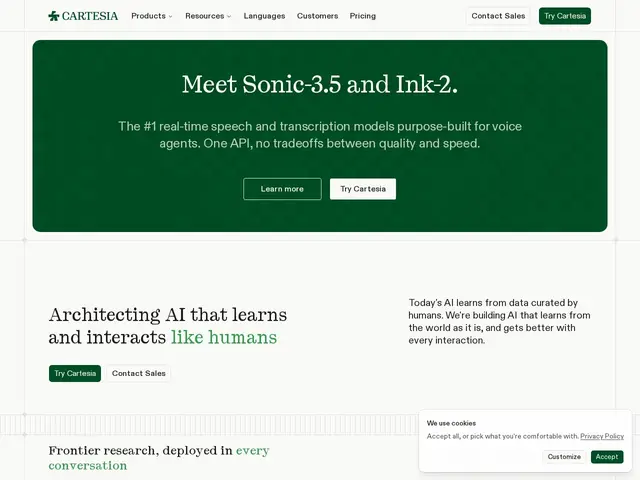
Description
A voice AI agent only feels natural if it responds as fast as a person would — any noticeable delay between a question and its spoken answer breaks the illusion immediately. Getting speech generation down to that speed, while still sounding human rather than robotic, is a genuinely hard technical problem. Cartesia specializes in exactly that: real-time speech models tuned for the lowest possible latency without sacrificing voice quality.
Cartesia builds real-time text-to-speech and speech-to-text models on a State Space Model (SSM) architecture rather than the more common transformer approach, which it uses to achieve very low-latency generation suitable for live conversation. It offers cloud, on-premise and on-device deployment, an enterprise voice-agent product called Line, and instant voice cloning. The company markets itself as ranked #1 on Artificial Analysis speech leaderboards and targets regulated, high-stakes industries — financial services, healthcare, government, fraud detection and customer support — where both latency and reliability matter. Pricing runs on a credits model: Free (20,000 credits/month), Pro at $5/month (100,000 credits), Startup at $49/month (1.25M credits), Scale at $299/month (8M credits), with custom Enterprise pricing, plus per-minute voice-agent call rates (~$0.06/min) and telephony (~$0.014/min).
💬 Our review
The short version: Cartesia's whole pitch rests on being genuinely fast — using an SSM architecture instead of the transformer approach most competitors use — and if the #1 leaderboard ranking it advertises holds up under your own testing, that's a real, measurable reason to pick it for latency-sensitive voice agents specifically.
The honest comparison is against Deepgram (broader, bundles STT+TTS+LLM orchestration in one API) and Rime (also latency-focused, with a stronger claim on voice naturalness and language breadth). Cartesia's low entry price ($5/month for the Pro tier) makes it cheap to test against those alternatives directly, which is the sensible way to decide — leaderboard rankings from any vendor's own marketing are worth verifying against your specific use case rather than taking at face value. For a voice agent where every 100ms of latency measurably hurts the user experience (real-time phone support, live translation), Cartesia's architecture bet is worth testing first; for less time-sensitive use cases, the latency difference may not justify picking it over a more full-featured alternative.
💰 Pricing
📊 Global score
🤖 AI-enriched data
Free: 20K credits/mo. Pro: $5/mo, 100K credits. Startup: $49/mo, 1.25M credits. Scale: $299/mo, 8M credits. Enterprise: custom. Voice agent calls ~$0.06/min, telephony ~$0.014/min.
Pros
State Space Model architecture built specifically for low-latency real-time speech
Cloud, on-premise and on-device deployment options
Very cheap entry tier ($5/month) to test before committing
Cons
Leaderboard/ranking claims are self-reported marketing, worth independent verification
Narrower feature set than bundled platforms like Deepgram's Voice Agent API
Per-minute voice-agent call costs (~$0.06/min) add up at high call volume