ZEDEDA
Edge orchestration platform that remotely manages, secures and updates AI inference and applications across thousands of distributed edge devices.
🔗 Visit ZEDEDA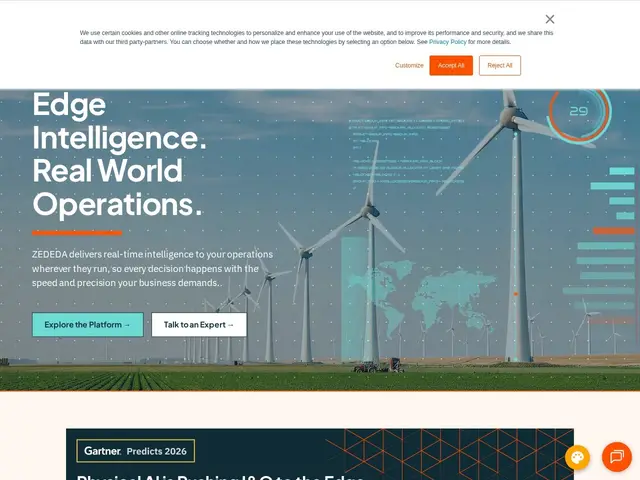
Description
Picture a company with thousands of small computers scattered across factories, delivery trucks, retail stores or oil rigs — each one needs its software kept up to date and secure, but sending a technician to physically visit every single machine would be impossible. ZEDEDA is like a remote control tower for all of those computers: it lets an IT team push updates, monitor health and lock down security from one central dashboard, without ever touching the hardware in person.
ZEDEDA is an edge orchestration platform built around EVE-OS, an open, hardware-agnostic operating system that runs on distributed edge nodes and gives each device a zero-trust security posture anchored in a hardware TPM root of trust. On top of EVE-OS, the ZEDEDA Cloud console handles remote fleet management, container and VM lifecycle orchestration, and deployment of AI inference workloads and autonomous agents at the edge, at a scale of thousands of nodes. It targets enterprises in manufacturing, logistics, retail and other environments where compute has to live physically close to sensors and machines rather than in a data center — increasingly to run local AI models where round-tripping data to the cloud is too slow, too expensive, or against data-residency rules.
💬 Our review
The short version: ZEDEDA solves a genuinely hard problem — keeping thousands of physically scattered, unattended computers secure and up to date — and it does it with real hardware-rooted security rather than a thin management UI bolted onto generic Linux boxes.
The TPM-anchored zero-trust model is the differentiator worth paying for: competitors like AWS IoT Greengrass or Azure IoT Edge assume you're already committed to their cloud, while ZEDEDA stays hardware-agnostic across a mixed fleet, which matters a lot in manufacturing and logistics where equipment gets replaced on its own schedule, not the cloud vendor's. The honest trade-off is that ZEDEDA is priced and sold like enterprise infrastructure — no public numbers, a sales conversation required, and a learning curve that only pays off once you're managing dozens or hundreds of nodes, not a handful. For a small pilot deployment, a lighter tool like Portainer will get you running faster and cheaper; ZEDEDA earns its keep once the fleet is large and mixed-vendor enough that hand-rolled management stops scaling.
💰 Pricing
📊 Global score
🤖 AI-enriched data
No public pricing — subscription-based, quoted per edge node/fleet size. Contact sales for a quote.
Pros
Hardware-rooted zero-trust security (TPM root of trust) rather than software-only isolation
Manages thousands of nodes from one console without on-site technicians
Hardware-agnostic — works across mixed edge device fleets, not locked to one vendor
Cons
No public pricing — a sales conversation is required before you know the cost
Enterprise-grade complexity is overkill for a handful of edge devices
Steeper learning curve than a general-purpose container orchestrator for teams new to edge computing