Interfaze
AI model purpose-built for tasks that need a consistent, reliable answer every time — reading documents, classifying content, transcribing speech.
🔗 Visit Interfaze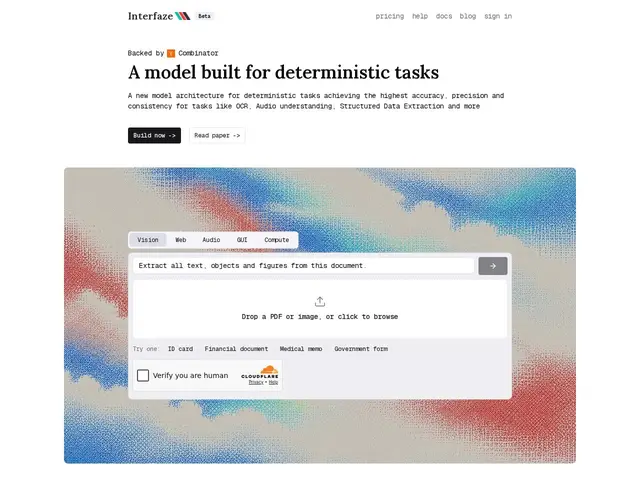
Description
General-purpose chatbots are great at open-ended conversation, but ask one to read the same invoice twice and it might extract the total slightly differently each time — which is a problem if you're feeding that output into a payment system. Interfaze is built for the opposite goal: give it the same document or audio clip twice, and it should give you back the same structured answer both times, with a confidence score attached so you know how much to trust it.
Interfaze is an AI model designed specifically for deterministic developer tasks — OCR, document data extraction, classification, object detection and speech-to-text — exposed through a REST API and a Chat Completion endpoint compatible with OpenAI, Vercel AI and LangChain SDKs, so it drops into an existing AI stack without a rewrite. It accepts multi-modal input (text, images, audio, files, video), supports a 1-million-token context window with up to 32k tokens of output, returns confidence scores and bounding boxes alongside extracted data, and includes content-safety guardrails plus a built-in sandbox and token caching. Founded in 2025 and backed by Y Combinator, Interfaze offers a free tier alongside usage-based pricing at $1.50 per million input tokens and $3.50 per million output tokens, with an Enterprise tier adding volume discounts, VPC/self-hosted deployment, and SOC 2/HIPAA compliance.
💬 Our review
The short version: Interfaze targets a real, specific pain point — general LLMs are non-deterministic and that's actively bad for extraction pipelines where the same input should always produce the same structured output, and Interfaze's confidence scores and bounding boxes make its outputs auditable in a way a raw chatbot response isn't.
It's a young, small team (five employees as of its YC batch) going up against both dedicated document-AI products from major clouds (AWS Textract, Google Document AI) and general-purpose LLM APIs that can be prompted into structured extraction reasonably well. The honest trade-off: cloud-native OCR tools are more battle-tested for pure document extraction and often cheaper at scale, while general LLM APIs are more flexible for open-ended tasks. Interfaze's edge is being purpose-built for determinism across a wider range of input types (text, image, audio, video) in one API, which is worth paying for specifically if your pipeline needs consistent, auditable extraction across mixed media rather than just plain-text OCR.
💰 Pricing
📊 Global score
🤖 AI-enriched data
Free tier available. Paid: $1.50/1M input tokens, $3.50/1M output tokens. Enterprise: volume discounts, VPC/self-hosted, SOC2/HIPAA.
Pros
Deterministic outputs with confidence scores and bounding boxes, not just free-text answers
Multi-modal in one API — text, images, audio, files, video
OpenAI/Vercel AI/LangChain-compatible endpoint drops into existing stacks
Cons
Very young company (2025 founding, 5 employees) with limited track record
Competing against more battle-tested cloud document-AI products for pure OCR
Per-token pricing on top of a small team means less predictable long-term support