Cortex
Internal developer platform that auto-maps a company's services into a catalog and uses scorecards to track production readiness, compliance and AI-adoption impact.
🔗 Visit Cortex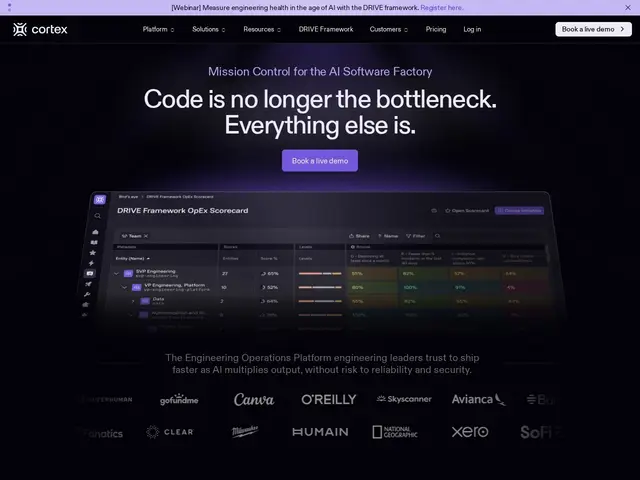
Description
When a company has hundreds of microservices spread across dozens of teams, leadership usually has no real answer to "which of these are actually production-ready and secure?" — the information exists, just scattered across wikis, Slack threads and people's heads. Cortex builds one map of every service a company runs, then scores each one against the standards that actually matter (security, reliability, ownership), so gaps are visible instead of discovered during an incident.
Cortex is an internal developer platform that automatically maps an organization's engineering data into a service catalog and context graph, then layers operational Scorecards on top to track production readiness, compliance and — increasingly — how much impact AI coding agents are having on a team's output. It provides "golden path" templates for standardized infrastructure provisioning and service scaffolding, plus self-service capabilities integrated with a company's existing tools. It's YC-backed, SOC 2 Type 2 and ISO 27001 certified, with Fortune 500 customers like H&R Block and Rapid7.
💬 Our review
The short version: Cortex is for engineering leaders who need to prove — with data, not vibes — which services are healthy, compliant and actually production-ready across a large organization.
Where it distinguishes itself from Port and Backstage is the emphasis on Scorecards as the primary product surface: Cortex's pitch is fundamentally about measurement and enforcement (is this service meeting our standards?) rather than Port's stronger lean toward self-service automation, or Backstage's open-ended "build whatever catalog you want" flexibility. The newer angle — scorecards that measure AI coding agent adoption and impact — is a genuinely current-moment feature as engineering leaders scramble to quantify whether AI tools are actually paying off, though it's too new to have a long track record either. As with Port, pricing is entirely custom and gated behind a sales demo, which is standard for this category but means there's no way to self-evaluate cost before a sales conversation. For an engineering organization whose main pain is inconsistent service quality and compliance visibility across many teams, Cortex's scorecard-first approach is a strong fit; for a team whose pain is more about developer self-service, Port's Actions-first model may serve better.
💰 Pricing
📊 Global score
🤖 AI-enriched data
Custom pricing; requires booking a demo, no self-serve signup or public pricing tiers.
Pros
Automatic service catalog and context graph mapping across an entire engineering org
Scorecards enforce production-readiness, compliance and reliability standards with real data
New scorecards specifically for measuring AI coding agent adoption and impact
SOC 2 Type 2 and ISO 27001 certified, proven with Fortune 500 customers
Cons
No public pricing — requires a sales demo to get a quote
Scorecard/measurement-first approach means less emphasis on self-service automation than Port
AI-adoption scorecards are a new feature without a long track record yet