Port
Internal developer portal that gives engineering teams a self-service software catalog, golden-path automation, and scorecards, positioned as faster to stand up than Backstage.
🔗 Visit Port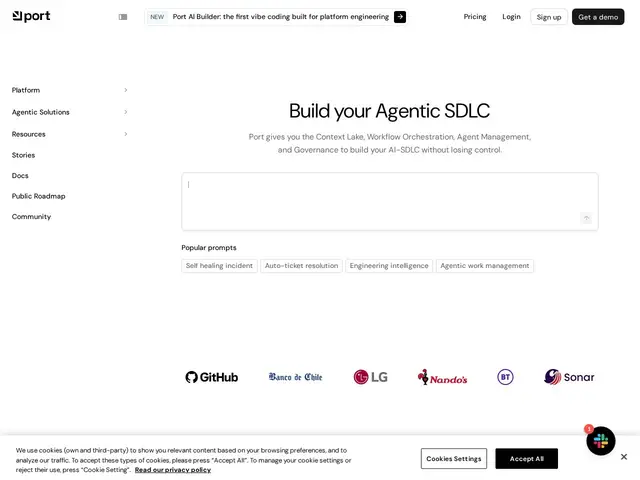
Description
As a company grows past a handful of engineers, nobody can keep track anymore of which team owns which service, which ones are actually production-ready, or how to spin up a new one the "right" way — so people either ask around on Slack or copy-paste an old project and hope for the best. Port is a shared, searchable map of everything a company builds, plus self-service buttons for the common requests ("give me a new service", "provision this database") that would otherwise become a ticket to a platform team.
Port is a platform engineering / internal developer portal product providing a software catalog and "Context Lake" that automatically maps an organization's services and environments, self-service Actions for provisioning infrastructure or running workflows with built-in approvals, Scorecards for measuring service quality and compliance, and AI agents that can autonomously handle tickets or incident remediation with governance controls. It integrates with 100+ tools (GitHub, Jira, Slack, Kubernetes, Terraform) and is used by companies including GitHub, Banco de Chile and BT.
💬 Our review
The short version: Port is aimed at the same problem as Spotify's open-source Backstage — a central catalog of what your company owns and how to work with it — but sold as a much faster-to-deploy commercial SaaS instead of a framework you assemble yourself.
That's the entire trade-off in this category: Backstage is free and infinitely customizable but needs real engineering investment (often a dedicated platform team) to stand up and maintain, while Port and its direct competitor Cortex are paid products that trade some of that flexibility for a production-ready portal "in a week" instead of months. Against Cortex specifically, Port leans more into self-service Actions and AI-agent automation for provisioning and incident response, while Cortex has traditionally emphasized operational scorecards and engineering maturity tracking — the fit depends on whether your bigger pain is "developers can't self-serve infrastructure" (Port) or "we can't measure service health across teams" (Cortex). The free tier caps at 15 seats and 10K entities, so evaluating it costs nothing, but real adoption at a mid-size engineering org will land in the $30-40/seat/month range, which is a real line item once you're past a few dozen engineers.
💰 Pricing
📊 Global score
🤖 AI-enriched data
Free: up to 15 seats, 10K entities, 500 automation runs. Basic: $30/seat/month (50 seats, 50K entities). Standard: $40/seat/month (200 seats, 250K entities, SSO). Enterprise: custom (unlimited seats, 1M+ entities).
Pros
Production-ready portal deployable in about a week vs. months for a self-built Backstage setup
Self-service Actions with approval workflows for infrastructure provisioning
AI agents for autonomous ticket resolution and incident remediation with governance
100+ integrations (GitHub, Jira, Slack, Kubernetes, Terraform) and a generous free tier
Cons
Less flexible than fully self-built and customized Backstage for organizations with unique needs
$30-40/seat/month adds up quickly once past a few dozen engineers
Overlaps heavily in positioning with Cortex — the choice between them is more about emphasis than features