TryCase
Gives AI coding agents disposable cloud Linux environments to actually run and test the code they write, capturing screenshots and recordings as proof instead of just claiming "done".
🔗 Visit TryCase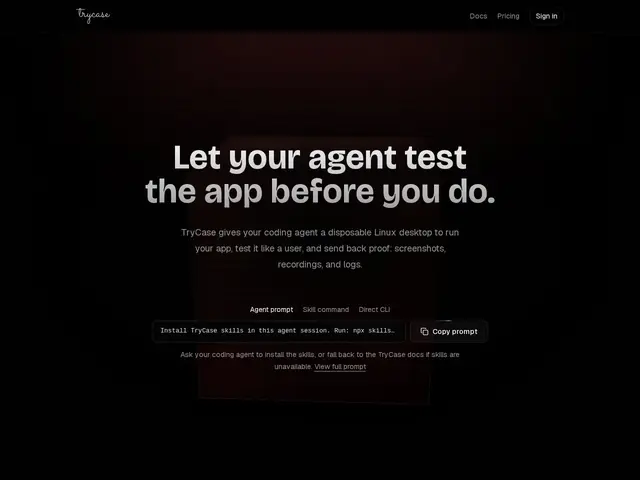
Description
AI coding assistants are good at writing code, but they're notoriously bad at knowing whether that code actually works — most just say "done" and move on, leaving a human to discover the bug later. TryCase gives the AI agent itself a disposable computer to test on: it can start the app, click around like a real user, take a screenshot, and only then honestly report back whether the change actually worked.
TryCase provides each coding agent (Claude Code, Cursor, Codex and compatible tools) its own disposable Linux desktop environment in the cloud, with terminal and browser control. The agent installs it as a skill via a single npx command, then can run the application, interact with it end-to-end, capture screenshots or video recordings and structured logs, and return that evidence instead of unverified code — with the environment destroyed once testing completes.
💬 Our review
The short version: TryCase solves a real, specific problem — AI coding agents that confidently say "this works" without ever having run it — by giving the agent a disposable sandbox to actually prove its work.
The closest comparison isn't really BrowserStack or Cypress, which are built for human-authored test suites — it's more of a category adjacent to Daytona and E2B (agent sandboxes), but purpose-built specifically for the "verify before claiming done" workflow rather than general-purpose code execution. That narrow focus is both the appeal and the risk: it's solving one sharp problem well, but as a small, likely solo-founder product with no disclosed funding or open-source repo, it carries more vendor-continuity risk than a funded infrastructure play like Daytona. The credit-based pricing ($19-199/month) is reasonable for individual developers or small teams who've been burned by agents claiming false victories, but teams already paying for Daytona or E2B sandboxes might get similar verification behavior by scripting it themselves rather than adding another subscription.
💰 Pricing
📊 Global score
🤖 AI-enriched data
Free: $0/month, 150 credits, 3 active environments, 30-min max duration. Pro: $19/month (19,000 credits). Max 5x: $79/month (79,000 credits). Max 20x: $199/month (199,000 credits). Team: $399/month (399,000 credits). Paid tiers: 5-50 active environments, 120-min max duration.
Pros
Purpose-built for the specific 'verify AI agent's work before trusting it' workflow
One-command (npx) install as a skill for Claude Code, Cursor and Codex
Captures screenshots, video and structured logs as proof of testing
Free tier available with no card required
Cons
Small, likely solo-founder product with no disclosed funding or public roadmap
Not open source — no visibility into how the sandboxing is implemented
Narrower scope than general-purpose agent sandbox platforms like Daytona or E2B