Vela
Serverless, Git-style branchable PostgreSQL platform for Kubernetes and private cloud, built on distributed NVMe storage for instant, full-copy database branches.
🔗 Visit Vela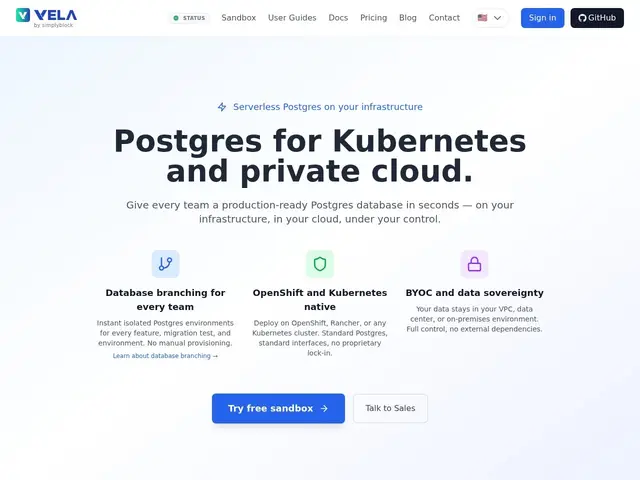
Description
Testing a database migration or letting a QA engineer poke at real-looking data usually means either risking the production database or waiting for someone to spin up a slow, expensive copy. Vela makes copying an entire database as fast and cheap as creating a Git branch: a full, isolated, working copy appears in about a second, without duplicating the underlying data.
Vela is a serverless PostgreSQL platform built by simplyblock for Kubernetes, OpenShift and private cloud deployments. It uses copy-on-write technology on distributed NVMe storage to let teams branch a full production-sized database (even a 1TB one) in under a second, alongside point-in-time recovery, RBAC, audit trails and real-time performance monitoring — while keeping full data sovereignty by running entirely inside a customer's own VPC, data center or on-prem environment. It's open source (Apache 2.0) and reached public beta in February 2026, claiming up to 290,000 TPS peak throughput.
💬 Our review
The short version: Vela is aimed squarely at teams that need Neon-style instant database branching but can't or won't put their data in someone else's public cloud — think regulated industries, private cloud shops, or Kubernetes-native infrastructure teams.
That's the real differentiator against Neon and PlanetScale, both of which are managed public-cloud services: Vela runs entirely inside your own Kubernetes cluster or private cloud, which matters if data sovereignty or on-prem requirements rule out a hosted database-as-a-service. Being open source (Apache 2.0) with a public GitHub repo also gives it a credibility path that pure-SaaS competitors don't offer. The obvious caveat is that this only reached public beta in February 2026 — it's genuinely new, with a much smaller community (146 GitHub stars vs. Neon's much larger footprint) and less battle-testing in production than incumbents, so teams should weight that immaturity against the sovereignty benefit. For a Kubernetes-native or compliance-constrained team that specifically needs self-hosted database branching, Vela is worth a pilot; for a team happy on public cloud, Neon is the more proven choice today.
💰 Pricing
📊 Global score
🤖 AI-enriched data
Free hosted sandbox tier for evaluation, no card required. Self-hosted Enterprise deployments priced on contact — custom based on infrastructure scale.
Pros
Full-copy database branching in under a second via copy-on-write NVMe storage
Runs entirely inside your own Kubernetes cluster, private cloud or on-prem — full data sovereignty
Open source (Apache 2.0) with an active public GitHub repo
Claims 290,000 TPS peak throughput with point-in-time recovery and audit trails
Cons
Only reached public beta in February 2026 — genuinely new and less battle-tested than incumbents
Much smaller community (146 GitHub stars) than established alternatives like Neon
Requires Kubernetes/private-cloud operational knowledge to self-host, unlike a pure managed SaaS