Artie
Fully-managed change-data-capture platform that streams database changes into data warehouses in real time, without building Kafka/Debezium pipelines yourself.
🔗 Visit Artie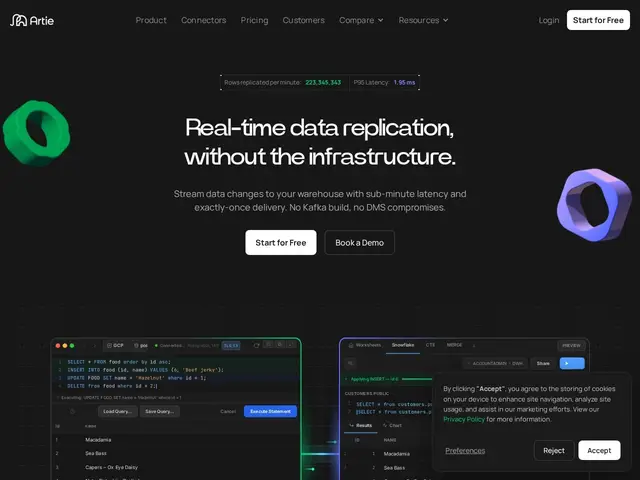
Description
When a row changes in your production database, most companies find out about it hours later, during the next nightly batch job that copies data into their analytics warehouse. Artie closes that gap: it watches your database's own internal change log and streams every update into your warehouse within a minute, so dashboards and AI systems are working off data that's actually current, not yesterday's.
Artie is a fully-managed change data capture (CDC) platform that replicates changes from source databases (PostgreSQL, MySQL, MongoDB, DynamoDB, SQL Server, Oracle, CockroachDB and more) into destinations like Snowflake, BigQuery, Databricks, Redshift and ClickHouse, with sub-minute latency and exactly-once delivery. It handles schema evolution, column-level data masking, and Slowly Changing Dimension patterns automatically, and is designed to deploy without a team having to stand up Kafka or Debezium themselves — a YC-backed company (S23) that raised a $12M Series A.
💬 Our review
The short version: Artie is for data teams who want real-time-ish data warehouse sync without the multi-week project of standing up and operating Kafka and Debezium in-house.
The pitch against building it yourself is legitimate — CDC pipelines built on raw Debezium are notoriously fiddly to keep running reliably (schema drift breaks things constantly), and Artie's managed approach with automatic schema evolution handling removes a real operational burden. Compared to Fivetran or Airbyte, which cover CDC as one connector among hundreds of general-purpose ETL sources, Artie is narrower and more specialized specifically for low-latency database-to-warehouse replication, which shows in the sub-minute latency claim. The trade-off: pricing starts around $500/month and scales with row volume, so for a team with light replication needs a broader tool like Airbyte's free self-hosted tier may be cheaper, and being a smaller, newer company (vs. Fivetran's maturity) is a real consideration for anyone risk-averse about vendor longevity. For a data team that specifically needs fast, reliable CDC without an in-house platform team, Artie is a sound, focused choice.
💰 Pricing
📊 Global score
🤖 AI-enriched data
Growth plan starts at $500/month, usage-based with volume discounts scaling to billions of rows. Initial snapshots/backfills are free. Enterprise plan offers BYOC and dedicated infrastructure at custom pricing. 14-day free trial, no card required.
Pros
Sub-minute latency CDC with exactly-once delivery guarantees
No need to operate Kafka or Debezium infrastructure yourself
Automatic schema evolution and Slowly Changing Dimension handling
Available via AWS Marketplace and Snowflake Marketplace for easy procurement
Cons
Starts at $500/month, pricier than self-hosting open-source Airbyte or Debezium
Smaller, newer vendor (2023) compared to established players like Fivetran
Focused specifically on CDC — not a general-purpose ETL tool for arbitrary API sources