Treasury Prime
Banking-as-a-service API connecting fintechs and platforms to a network of US sponsor banks, for launching accounts, cards and payments without becoming a bank.
🔗 Visit Treasury Prime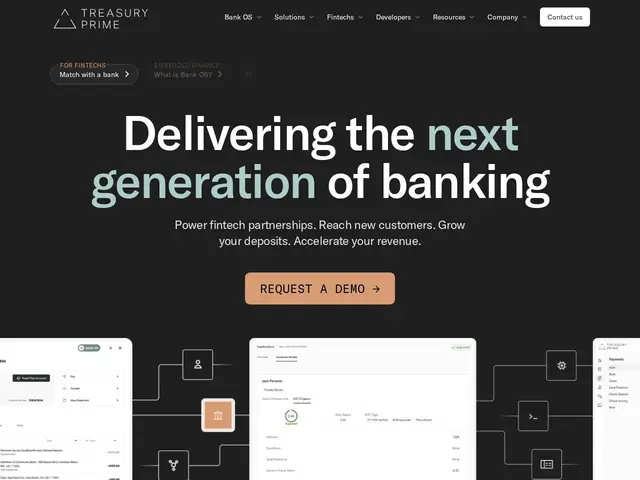
Description
Building a product that needs to hold customer money, issue accounts, or move payments usually means either becoming a licensed bank yourself — a years-long, extremely expensive process — or partnering with one. Treasury Prime is the plumbing that makes the second option realistic: a REST API that plugs your app into a real, FDIC-regulated bank's infrastructure, so you can offer banking features without holding a banking charter.
Treasury Prime is a "Bank Operating System" that lets fintechs, neobanks and other companies build embedded banking products through a unified REST API connected to a network of 20+ partner sponsor banks. It provides virtual ledger/sub-ledger account management, ACH/wire/real-time payment rails, white-label digital experiences, and compliance program tooling, plus a developer sandbox for testing before going live. The platform has facilitated over $10B in deposits and 2.5M+ new accounts across its bank partners.
💬 Our review
The short version: Treasury Prime is infrastructure for companies that want to offer real banking features — FDIC-insured accounts, cards, payments — without becoming a bank themselves, and it earns its keep by giving you a choice of sponsor banks instead of locking you to one.
The multi-bank network is the meaningful differentiator against a single-bank BaaS partnership: if your sponsor bank relationship sours or can't scale with you (a real risk in this industry, as several BaaS partnerships have shown), Treasury Prime's model is built around being able to route to a different partner bank rather than rebuilding your entire banking stack. The catch is the same one every BaaS platform shares — pricing isn't public, the sales and compliance onboarding process is inherently slow (banking regulation doesn't move fast for anyone), and this only makes sense if your product genuinely needs regulated banking rails, not just payment processing (which Stripe alone can do more simply). For a fintech or platform building a real banking product, the sponsor-bank flexibility is valuable insurance; for a company that just needs to accept and send payments, it's more infrastructure than necessary.
💰 Pricing
📊 Global score
🤖 AI-enriched data
Custom pricing based on transaction volume and feature set; requires a demo and sales conversation.
Pros
Access to a network of 20+ sponsor banks instead of a single-bank lock-in
Virtual ledger accounts, ACH/wire/real-time payments in one API
$10B+ in deposits and 2.5M+ accounts facilitated across bank partners
Developer sandbox for testing before regulatory go-live
Cons
No public pricing — sales and compliance onboarding cycle required
Only useful if you actually need regulated banking rails, not just payment processing
Banking-as-a-service partnerships are inherently slower to launch than a plain payments API