Orb
Developer-first usage-based billing platform with SQL-defined pricing metrics, built for SaaS and AI companies with complex or metered pricing.
🔗 Visit Orb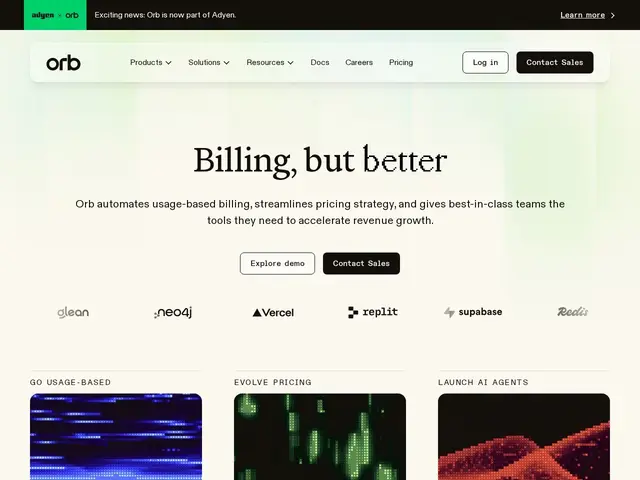
Description
Charging customers a flat monthly fee is easy; charging them based on how much they actually use — API calls, tokens, seats that fluctuate mid-month — usually turns into a spreadsheet nightmare of custom invoicing code nobody wants to maintain. Orb exists so a team can define "here's how we charge for this" as a query instead of a pile of billing edge-case code, and get correct, auditable invoices out the other end.
Orb is a usage-based billing platform aimed at SaaS and AI companies with complex pricing (seat-based, token-based, per-action, or hybrid). It captures usage events in real time, lets teams define pricing metrics with custom SQL, generates invoices with backdating support, and adds finance workflows on top — revenue recognition (ASC 606), accounts receivable, and dunning — plus CRM/ERP sync (Salesforce, NetSuite). The platform is built to process over 1 million billing events per second and is used by companies including Vercel, Replit and LaunchDarkly.
💬 Our review
The short version: Orb is for companies whose pricing is genuinely complicated — token-metered AI usage, tiered seat pricing, hybrid contracts — and who've outgrown what Stripe Billing or a homegrown invoicing script can cleanly express.
The SQL-based metric definition is the real differentiator against Lago and Metronome: instead of configuring pricing through a UI with limited flexibility, engineers write a query that defines exactly what counts as billable usage, which matters a lot once your pricing has enough exceptions that a form-based billing tool starts fighting you. The honest catch is that Orb doesn't publish pricing — it's an enterprise sales process, and companies with straightforward subscription pricing don't need this much billing infrastructure at all (Stripe Billing handles that for a fraction of the implementation effort). If your product has metered, usage-based, or genuinely complex pricing at real scale, Orb is worth the sales call; if you're charging a flat $29/month, this is over-engineering.
💰 Pricing
📊 Global score
🤖 AI-enriched data
Custom pricing based on invoice billings issued and raw billing events ingested. Three tiers: Core (usage-based billing setup), Advanced (data warehouse sync + ERP integration), Enterprise (dedicated support, mission-critical SLAs). No free trial — contact sales.
Pros
SQL-defined pricing metrics give real flexibility for complex usage-based models
Processes 1M+ billing events per second at scale
Built-in finance workflows: ASC 606 revenue recognition, AR, dunning automation
Trusted by scaled infra/AI companies (Vercel, Replit, LaunchDarkly)
Cons
No public pricing — enterprise sales process required to get a quote
Overkill for companies with simple flat-rate subscription pricing
SQL-based configuration requires engineering time to set up and maintain, unlike a pure no-code billing UI