Statsig
Combined feature flag, A/B testing, product analytics and session replay platform, built to answer whether a feature actually worked, not just whether it shipped.
🔗 Visit Statsig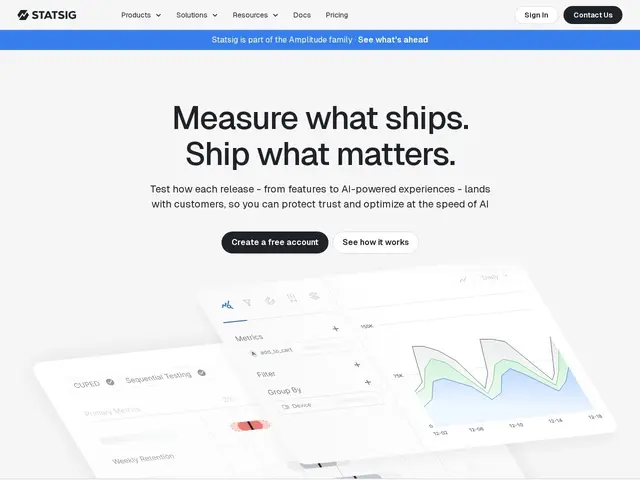
Description
Turning a feature on for users is easy; knowing whether it actually made things better is the hard part — usually requiring a separate analytics tool, a separate experimentation tool, and someone to manually connect the two afterward. Statsig puts feature flags, A/B testing and analytics in one system, so the moment a flag ships, you can already see its effect on real user behavior.
Statsig is a platform combining feature flags and configuration management, A/B experimentation with advanced statistical analysis, product and web analytics, and session replay linked to specific experiments and metrics. It supports warehouse-native experiment execution (running experiments directly against a company's existing data warehouse) and ships SDKs for 20+ languages and frameworks including React, Node.js, Python and Go. The Developer tier is free with 2 million events/month; Pro is $150/month for 5 million events; Enterprise pricing is custom with volume discounts. Customers include OpenAI, Brex and Notion.
💬 Our review
The short version: Statsig's bet is that feature flags and experimentation shouldn't be separate from analytics — you flip a flag and immediately see, in the same tool, whether it moved the metrics you care about, instead of exporting data to a BI tool afterward.
Warehouse-native experimentation is the standout feature here: running statistical experiment analysis directly against a company's own Snowflake or BigQuery data, rather than routing everything through a proprietary event pipeline, is a meaningfully different architecture from LaunchDarkly's flag-first approach and appeals to data teams that already trust their warehouse as the source of truth. Session replay tied to specific experiment variants also closes a real gap — seeing not just that a metric moved but watching what users in the affected group actually did. The honest trade-off: Statsig is younger and less battle-tested at enterprise scale than LaunchDarkly, and its core repositories are largely private, so the open-source trust signal is thinner than the 768 GitHub stars alone suggest. For product-led teams that want flags, experiments and analytics genuinely unified rather than integrated after the fact, Statsig is a strong, more analytics-native alternative; teams prioritizing proven enterprise reliability above all else may still default to LaunchDarkly.
💰 Pricing
📊 Global score
🤖 AI-enriched data
Developer: free, 2M events/month. Pro: $150/month, 5M events. Enterprise: custom pricing with volume discounts.
Pros
Feature flags, A/B testing and product analytics genuinely unified, not bolted together
Warehouse-native experiment execution against existing Snowflake/BigQuery data
Session replay linked directly to specific experiments and metrics
Cons
Younger, less enterprise-battle-tested than LaunchDarkly
Core platform repositories are largely private, thinner open-source trust signal