Qodo
AI code review and governance platform that reviews pull requests with full multi-repository context and enforces team coding standards automatically.
🔗 Visit Qodo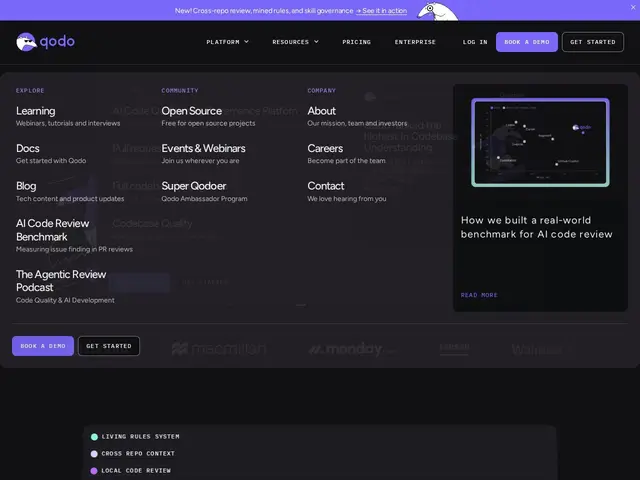
Description
A human reviewing a pull request usually only sees the files that changed, not the whole codebase — so a change that breaks something in a different, unrelated part of the system can slip through. Qodo gives its AI reviewer access to the full context across a company's repositories, so it can catch "this looks fine here, but it'll break that other service" problems that a rushed human reviewer or a narrower AI tool would miss.
Qodo is an AI code review and governance platform offering agentic issue-finding with context-aware suggestions, local IDE review (VS Code, JetBrains, Visual Studio), cross-repository context and breaking-change detection, a "living rules" system to enforce coding standards automatically, multi-agent PR review, and a governance portal with risk intelligence and audit trails for engineering leadership. Its open-source sub-project, Qodo-Cover, generates AI-powered tests and has 5.5k GitHub stars under AGPL-3.0. Enterprise customers include Intel, NVIDIA, Walmart, Intuit and Box. Pricing is credit-based at $0.012/credit, with a 14-day free trial of unlimited reviews, a Pro Team plan at $30/month for up to 30 users, and Enterprise plans with SSO, BYOK (bring your own key) and single-tenant deployment.
💬 Our review
The short version: Qodo's edge over a generic AI code reviewer is cross-repository context — it can flag when a change in one service will break another, something most PR-level review tools structurally can't see.
The "living rules" system, which enforces a team's coding standards automatically rather than relying on a static linter config, and the governance portal with audit trails aimed at engineering leadership both signal a platform built for larger organizations that need consistency and accountability across many repos and teams — which tracks with its enterprise customer list (Intel, NVIDIA, Walmart). Having a genuinely open-source component (Qodo-Cover, 5.5k stars) also gives outsiders a way to evaluate code quality before trusting the paid platform. The honest trade-off: credit-based pricing at $0.012/credit is harder to budget predictably than a flat per-seat fee, and cross-repo context is most valuable for organizations with many interconnected services — a small team with one or two repos won't see much benefit over a lighter tool like Graphite or GitHub's built-in AI review. For engineering orgs managing many interdependent repositories, Qodo's context breadth is a real advantage; small, single-repo teams may find it more platform than they need.
💰 Pricing
📊 Global score
🤖 AI-enriched data
Credit-based: $0.012/credit. 14-day free trial with unlimited reviews. Pro Team: $30/month for up to 30 users. Enterprise: custom, with SSO, BYOK and single-tenant deployment.
Pros
Cross-repository context catches breaking changes other tools miss
Living rules system enforces coding standards automatically
Governance portal with audit trails for engineering leadership
Cons
Credit-based pricing is less predictable than a flat per-seat fee
Cross-repo context benefit is limited for small, single-repo teams