Graphite
Code review platform built around stacked pull requests and AI review, designed to keep changes small and merge conflicts rare.
🔗 Visit Graphite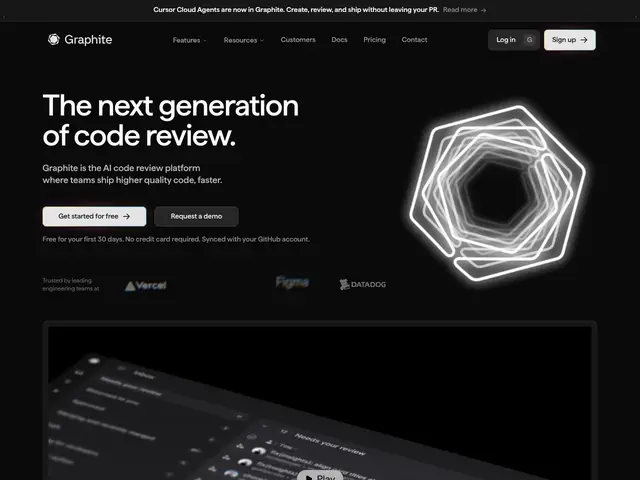
Description
When a developer's work sits in one giant pull request for days waiting on review, it becomes stale, hard to review carefully, and prone to merge conflicts by the time it's approved. Graphite encourages breaking that work into a "stack" of small, sequential pull requests that can each be reviewed and merged quickly, plus an AI reviewer that gives instant feedback while a human review is still pending.
Graphite is a code review platform centered on stacked pull requests — sequencing related changes so they can be reviewed and merged independently without waiting on the whole feature, reducing merge conflicts. It layers AI code review with automatic suggested fixes, "Graphite Chat" (a collaborative AI reviewer directly on the PR page), a stack-aware merge queue, a unified PR inbox for team review workflow, and CLI/VS Code integration with Slack notifications and dev-metrics dashboards. The Hobby tier is free for personal projects, Starter is $20/user/month, Team is $40/user/month with unlimited AI reviews and automations (both billed annually), and Enterprise offers custom pricing with advanced controls. Customers include Neon, Semgrep, Shopify, Ramp and Asana, with Ramp reporting 3x faster shipping and Asana reporting 7 hours/week saved per engineer.
💬 Our review
The short version: Graphite's stacked-PR workflow attacks a different problem than most AI code review tools — not "is this code good" but "why does review take so long and cause so many merge conflicts" — and it bundles AI review on top rather than as the whole product.
Stacked PRs are a genuinely different (and for many teams, better) unit of work than one giant feature branch: smaller reviewable chunks merge faster and conflict less, and Graphite's merge queue is stack-aware, meaning it understands dependencies between stacked changes that a generic merge queue would trip over. The customer-reported numbers — 3x faster shipping at Ramp, 7 hours/week saved per engineer at Asana — are strong if representative, though they're vendor-selected case studies rather than independent benchmarks. The honest trade-off: the stacked-PR workflow itself is a process change that takes real team buy-in to adopt, unlike an AI reviewer you can bolt onto an existing workflow with zero process change, and at $20-$40/user/month it's a recurring per-seat cost. For teams that want to fundamentally speed up their review cycle, not just add an AI second-opinion, Graphite's stacking model is worth the workflow shift; teams that just want an AI reviewer without changing how they branch should look at CodeRabbit or Qodo instead.
💰 Pricing
📊 Global score
🤖 AI-enriched data
Hobby: free for personal projects. Starter: $20/user/month (annual billing). Team: $40/user/month, unlimited AI reviews and automations. Enterprise: custom pricing.
Pros
Stacked PRs reduce merge conflicts and speed up review vs. one giant branch
Stack-aware merge queue understands dependencies between changes
Reported real-world results: 3x faster shipping (Ramp), 7 hrs/week saved (Asana)
Cons
Stacked-PR workflow requires real team process change to adopt
$20-$40/user/month recurring cost vs. free AI-review-only alternatives