Feast
Open-source feature store that manages the machine-learning data teams use for both model training and real-time predictions.
🔗 Visit Feast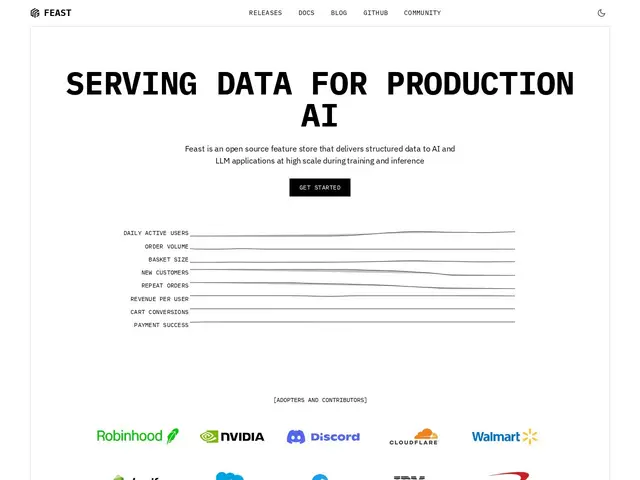
Description
Machine learning models are trained on historical data but make predictions in real time — for example, a fraud model trains on months of past transactions but must score a new transaction in milliseconds. Keeping those two versions of the same data consistent, so the model doesn't behave differently in production than it did in testing, is a surprisingly hard engineering problem. Feast is a free, open-source tool built specifically to solve that mismatch.
Feast is an open-source feature store: a system that lets ML teams define, store and serve the input variables ("features") models use, from both historical batch sources for training and low-latency online sources for real-time inference. It supports 10+ offline stores (Snowflake, BigQuery, Redshift, PostgreSQL) and 15+ online stores (Redis, DynamoDB, Cassandra, MySQL) through a common API, guarantees point-in-time-correct data to prevent leakage between training and serving, includes vector similarity search for RAG applications, and provides a feature registry with lineage tracking plus data-quality monitoring. It's fully free and open source under Apache-2.0, with no commercial tier — the project reports 12M+ downloads and a 5,500-member Slack community.
💬 Our review
The short version: Feast is the default open-source answer to "how do I keep my ML training data and production data consistent," and since it's completely free, it's an easy first choice before paying for a commercial feature platform.
Feast's genuine strength is being a thin, flexible abstraction layer over whatever databases a team already uses, rather than demanding a specific data stack — 10+ offline and 15+ online store integrations is a real breadth advantage over more opinionated platforms. Point-in-time-correct joins are the unglamorous but critical feature that prevents "training-serving skew," a bug class that silently degrades model accuracy in production. The honest trade-off: being open source and self-managed, Feast doesn't include managed infrastructure, support SLAs, or the more advanced feature-engineering pipelines that acquired/commercial platforms bundle in (Tecton's functionality, for instance, is now folded into Databricks). For teams with in-house data engineering capacity who want a free, vendor-neutral feature store, Feast is close to the standard choice; teams wanting a fully managed, hands-off experience should look at their existing cloud provider's managed feature store (SageMaker, Vertex AI) instead.
💰 Pricing
📊 Global score
🤖 AI-enriched data
Fully open source (Apache-2.0), no paid tier or commercial license
Pros
Completely free, Apache-2.0, no vendor lock-in
Works with 10+ offline and 15+ online stores you likely already run
Point-in-time-correct joins prevent training-serving skew
Cons
No managed hosting or commercial support included
Requires in-house data engineering to operate at scale