Fern
Generates polished API documentation and client SDKs in multiple languages directly from an OpenAPI spec.
🔗 Visit Fern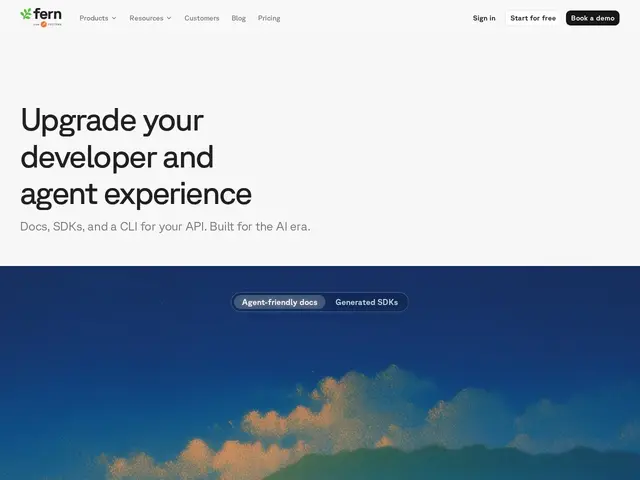
Description
A company that offers an API usually needs to hand developers two things: readable documentation, and ready-made code libraries in whatever language those developers use — and hand-writing and maintaining both, in sync, across Python, JavaScript, Go and more, is a job that eats an engineering team's time indefinitely. Fern reads the API's technical specification once and generates both the docs and the code libraries automatically, keeping them in sync as the API changes.
Fern is a platform for generating API documentation and SDKs from OpenAPI (and other) specifications, aimed at API-first companies that want a professional developer experience without a dedicated docs team. It auto-generates SDKs in multiple programming languages, supports REST, WebSockets, GraphQL, AsyncAPI and gRPC, includes AI-assisted authoring, an integrated AI chat/search for documentation (llms.txt generation for AI-agent-readable docs), a terminal CLI, MCP server integration, and self-hosting with SAML/OIDC authentication for enterprise needs. The core is Apache-2.0 open source with 3.7k GitHub stars. Pricing runs from a free Hobby tier (250 AI credits) through Team at $150/month (1,000 AI credits, 5 team members, version switching) to custom Enterprise pricing with dedicated support and SSO. Fern reports serving 8,000+ customers and generating 13,392+ SDKs.
💬 Our review
The short version: Fern removes one of the most tedious, easy-to-neglect jobs in API development — keeping docs and SDKs in every language in sync with the actual API — by generating both from a single source of truth.
Being genuinely open source (Apache-2.0, 3.7k stars) with a self-hosting option distinguishes it from competitors like ReadMe or Mintlify that are closed-source SaaS-only, which matters for companies with data-residency or vendor-lock-in concerns. Multi-protocol support (REST, WebSockets, GraphQL, AsyncAPI, gRPC) beyond just OpenAPI/REST is also broader than most docs-generation tools, and the 2026-native additions — llms.txt generation and MCP server integration — specifically target the reality that AI agents now consume API docs as much as human developers do. The honest trade-off: spec-driven generation is only as good as the underlying OpenAPI spec, so teams with messy or incomplete specs will get messy generated docs/SDKs until they invest in cleaning up the source spec first. For API-first companies wanting synchronized, multi-language docs and SDKs without a dedicated docs engineering team, Fern is a strong, credibly open-source choice; teams that specifically need ReadMe's live authenticated API playground for guided onboarding may prefer that instead.
💰 Pricing
📊 Global score
🤖 AI-enriched data
Hobby: free, 250 AI credits. Team: $150/month, 1,000 AI credits, 5 team members, version switching. Enterprise: custom, dedicated support, SSO, translated content.
Pros
Genuinely open source (Apache-2.0) with a self-hosting option
Generates SDKs in multiple languages, not just documentation
Supports REST, WebSockets, GraphQL, AsyncAPI and gRPC, not just REST
Cons
Generated output quality depends entirely on how clean the source OpenAPI spec is
Team tier ($150/month) is pricier than some pure-documentation competitors